
New York Authorizes a Land Value Tax to Fund Transit and More — Landscape 9
LVT continues to increase in conversation; Florida and Ohio fight over abolishing the property tax; Spokane runs the numbers; Colorado stalls; Duggan drops out

Welcome back to the Landscape, my recurring roundup of the momentum, legislation, and news shaping land value taxation. You can find the last installment, Landscape 8, where two states passed enabling legislation in a single week.
A quick note before we dig in: If you missed our LVT Landscape Live, the full video and transcript are up now.
This time: New York quietly authorizes a land value tax that could help fund the Interborough Express, the “abolish the property tax” movement keeps gathering steam, Spokane shows what the better alternative looks like in dollars and cents, we take an honest look at a couple of setbacks, and there’s an impressive stack of new writing to get through.
New York: A Land Value Tax to Fund the Interborough Express
The biggest land value tax news since the last update comes out of Albany… and it’s easy to miss, because it’s tucked inside a state budget. In the FY2027 budget Governor Kathy Hochul signed, New York renewed Section 119-r of the General Municipal Law, a transit value-capture provision that had lapsed in April.
Reed Schwartz and Alex Armlovich of the Niskanen Center laid out what that could mean: potentially billions of dollars in land value to help fund New York’s transit expansion, starting with the Interborough Express, the proposed Brooklyn-to-Queens line that would be the city’s first new end-to-end rapid transit in nearly a century.
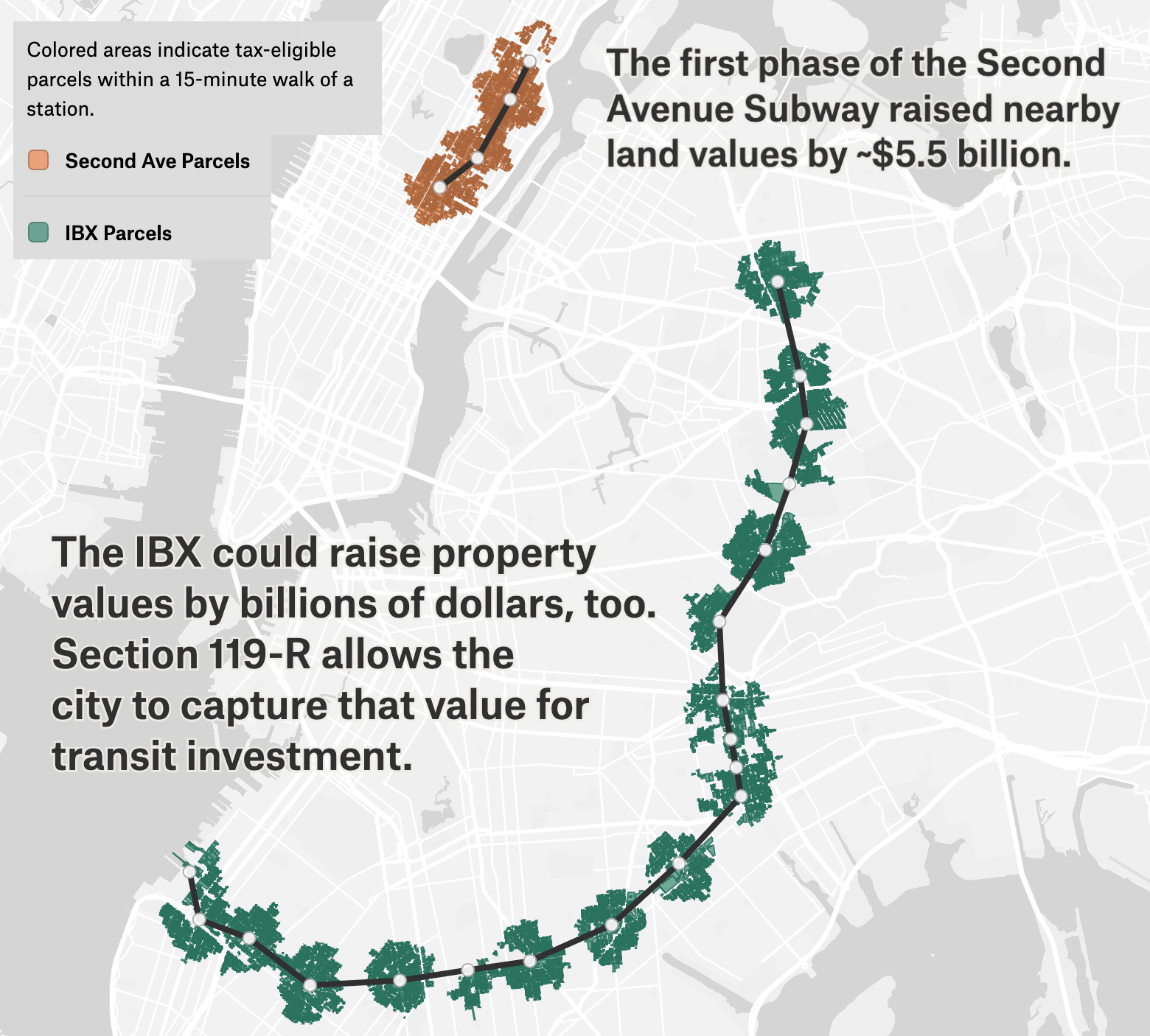
This is enabling legislation, not implementation. Section 119-r does not implement land value taxes, but it does give New York City the authority to set up a value-capture district along a new transit corridor and recover some of the land value the transit itself creates, either through a special assessment or a true land value tax (the statute names both). To actually stand one up, the City Council would still have to authorize it and the mayor would have to sign off.
We think the politics here are favorable. From the city level, the mayor, back in 2022 when this provision was about as low-salience as policy gets, was then-Assemblymember Zohran Mamdani and one of the only people talking about it, making 119-r part of his “Fix the MTA” package and introducing a bill to renew it and strip out its sunset. Now he’s mayor. From the state level, Governor Hochul put the renewal of the authority in her budget and is actively pushing the IBX forward.
Applying the land value uplift multipliers from Arpit Gupta’s study of the Second Avenue Subway, Reed and Alex estimate the IBX could generate somewhere between $1.5 and $3.5 billion in capturable land value.
The Property-Tax Revolt
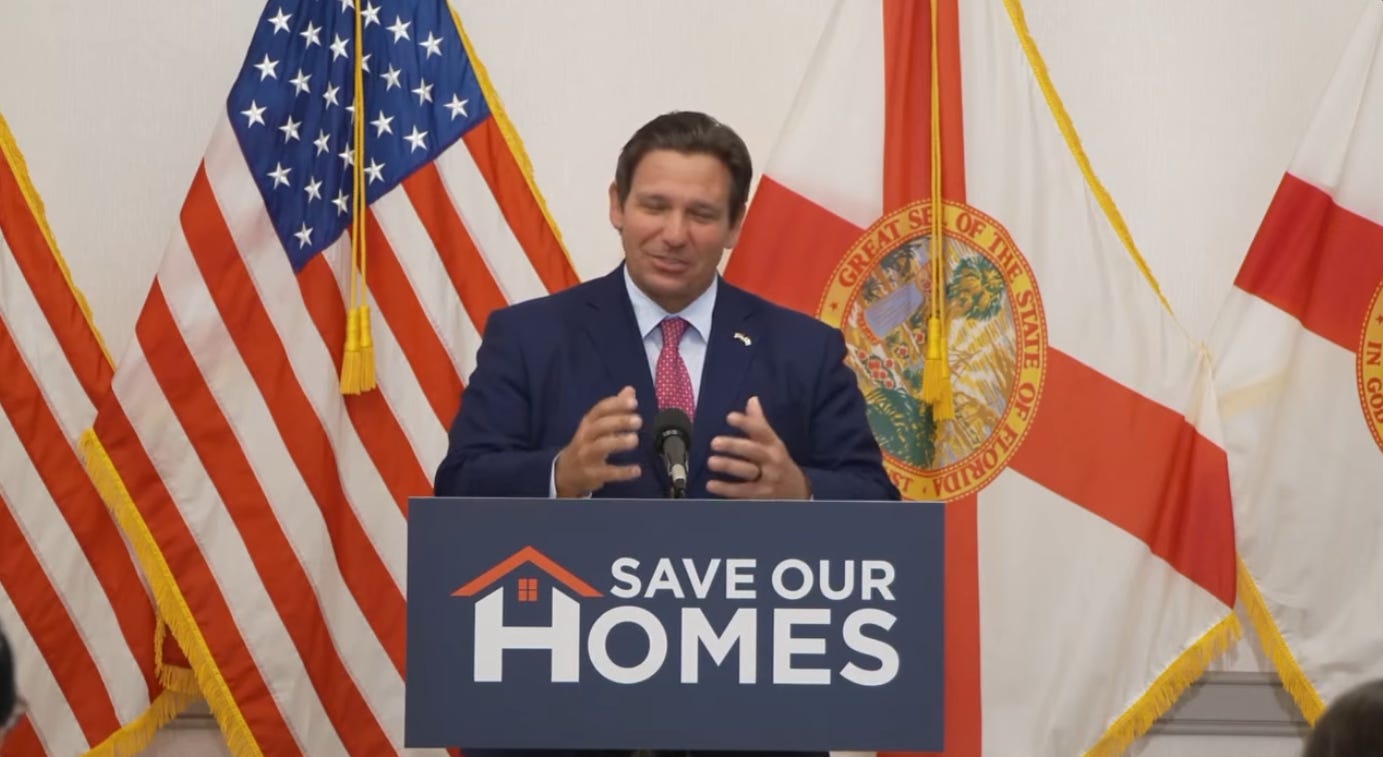
The biggest story in local tax policy right now is the movement to abolish the property tax altogether. For more than a year, Governor Ron DeSantis has pushed to wipe out homestead property taxes entirely. I wrote about this early, arguing that DeSantis is half right: the tax on buildings deserves to go, but the tax on land does not. DeSantis called a last-minute special session at the start of June to force the issue since the regular session did not deliver.
The proposal drew alarm from many directions. Fiscal analysts and local governments warned about the hole it would blow in local budgets, and even House Republicans balked at the governor’s full plan, paring it back so that school levies are spared. By the legislature’s own fiscal analysis, the measure would cut local revenue by an estimated $4.6 billion in its first year and $8.4 billion in its second
On June 2, lawmakers approved HJR 1, sending a “Save Our Homes” constitutional amendment to the November 2026 ballot, where it will need 60% approval. It is far short of abolition: a homestead-exemption expansion that raises the exempt amount to $250,000 in 2028, with school taxes still owed. But, DeSantis wants to pitch this as a first step toward eliminating homestead property taxes for good. An increased homestead exemption, on its own, isn’t the end of the world; my guess is the movement largely stops here for now–and I hope as much.
On WFLA’s Ryan Gorman Show, Jeff Brandes of the Florida Policy Project (and former State Senator), recently walked through whether the amendment delivers real relief; in it, he says the state should consider land value taxes.
The anti-property tax movement is the same one that Ohio State Senator Bill Blessing (R) is facing. He spoke very directly about it at our live event: “I’ve argued it would be like a meteor hitting Ohio,” he said, “an extinction-level event for the state.” Scrapping the property tax simply shifts the cost of government onto other taxes. Replacing Ohio’s roughly $24 billion in annual property tax revenue, Blessing noted, would mean “we’d have to roughly double the sales tax, more than double the income tax, and look under every couch cushion.”
For Blessing, the land value tax is “the most efficient tax there is,” and yet a constitutional prohibition would have Ohio “leaving our best player on the bench.”
The good news is that the counter-argument is breaking into mainstream venues. In Forbes, Jennifer Castenson made the case for why we need — and should want — higher property taxes. And in Commonplace, Michael Lind laid out the intellectual version of the same point, calling the land value tax “the least bad tax”.
Running the Numbers in Spokane
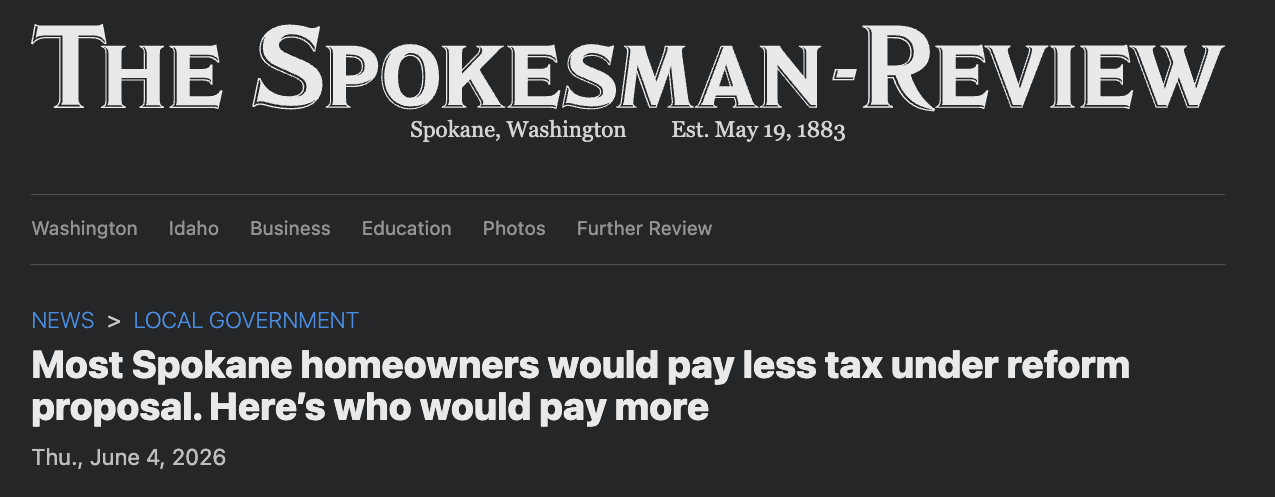
We have been working in Washington for the past year pushing land value taxes. This month we published a report modeling exactly what Spokane’s proposed property tax shift would do, parcel by parcel. The Spokesman-Review covered it, and the headline finding is the one that matters politically: most Spokane homeowners would pay less.
This is a city-and-state push with serious players behind it. Spokane Councilwoman Kitty Klitzke, a longtime infill advocate, frames it as the missing tool: “A property tax that exempts buildings and shifts the burden onto land would give us a new and powerful tool to fill in our gaps while keeping Spokane affordable. We’ve done all we can to incentivize infill development with the tools we currently have.”
At the state level, Rep. Natasha Hill (D-Spokane) put it this way: “This is another tool we have to update our tax code in order to incentivize development and disincentivize prospecting, or holding undeveloped or underdeveloped land for tax write-offs… We can and must change the system to remove burdens for development and increase land value, which benefits all property owners.”
We’re not the only ones making the case in Washington. Our partners at Sightline Institute, covering our report, argued this month that yes, a land value tax is possible in Washington State, even within the state’s constitutional constraints. The Spokane report also got picked up by Streetsblog’s Talking Headways podcast. And the report itself came out of our new LVT-shift modeling tool, which we wrote up on the Substack: it models a city’s shift, parcel by parcel, with essentially one command.
Headwinds: Colorado Stalls, Duggan Bows Out
In hyping land value taxes, I may sometimes give the impression that there are no headwinds. There certainly are. Property tax abolition being one of them, and I want to cover two others.
Colorado is the more instructive one. A bill to let local governments split their rates was postponed indefinitely by a House committee on an 8-3 vote after hours of testimony, including from us.
Having been at the testimony, we learned a lesson: you must do the homework. The right stakeholders weren’t brought in ahead of time. Small businesses and industry groups showed up with common misconceptions of the impact of the land value tax shift, and the moment they saw the word “tax” they reached for the reflexive “they’re trying to raise your taxes” scare tactic. That’s an avoidable own-goal.
There was genuine opposition from the assessors, who would have to implement the land value tax, with many Colorado specific concerns due to local complexities, such as those imposed by Colorado’s TABOR provisions. We have a lot of sympathy for assessors, so administrative concerns make sense, and there are typically ways legislation can make things easier to engage, so working with the administrative folks is important.
And then there was the golf course association, who opposed the bill because their golf courses would be negatively impacted. Cue the world’s smallest violin. Regardless, the initiative this year failed, but this does not minimize the possibility of a LVT in coming years, it will just require some more stakeholder wrangling.
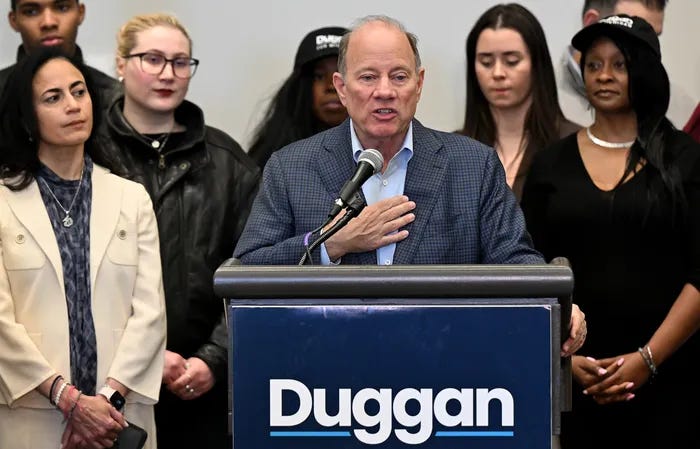
The next headwind for LVT comes from Michigan. Former Detroit Mayor Mike Duggan ended his independent campaign for governor on May 21, citing the difficulty of building national fundraising for an independent bid. As we covered in Landscape 6, Duggan had vowed to renew his land value tax push at the state level if elected. His exit takes the most prominent statewide LVT champion off the 2026 Michigan board. But, we can hope that someone else will take his mantle.
Assessments in the Spotlight
Because assessment quality is the soft underbelly of any land tax, it’s worth watching the cities where that fight is playing out in public.
In Madison, City Assessor Michelle Drea explained the recent jump in property values to the Cap Times — and, predictably, drew a sharp letter to the editor arguing the assessments are “designed to build at any cost.” Ben Noffke also walked through the new numbers on his Substack which is worth a read for the fuller picture.
Maryland: A Report, a Movement, and a Rule Change
Last August, Lars and I published a report at the Center for Land Economics showing that the state was systematically undervaluing vacant land in Baltimore by nearly half a billion dollars. Vacant lots zoned for rowhouse development were selling for more than eight times their assessed value.
Credit for making it stick goes to the grassroots movement behind it. Local advocates took the case through the local power players of electeds, and SDAT responded fast, launching a new initiative to reassess Baltimore’s vacant land and give it the same scrutiny as built-out property. The payoff is now showing up where it counts: this year’s reassessment in the affected zone added more than $100 million in new value to the tax roll.
SDAT also quietly rewrote its own procedures, an under-the-radar move to make this more durable. Its new residential land-valuation procedure, issued May 1st, bakes the fix into standard statewide practice. A few things worth flagging:
It reaffirms that assessors must separate every improved parcel into land and improvement components, and review land values at the start of each reassessment cycle.
It lets assessors treat a teardown sale — where a building is bought specifically to be demolished — as a vacant-land sale for comparison purposes.
Where vacant-land sales are scarce, it directs assessors to use the allocation approach — comparing assessed land value to total value — to flag lots whose land is being undervalued.
The Baltimore Thrive group in Maryland keeps running, too. In an April op-ed, “Taxes a barrier to transit-oriented development,” Baltimore Thrive’s coordinators, David Bjorndalen and Vanessa Beck, argued that taxing buildings penalizes the dense, walkable development we say we want around transit stations… and that shifting the burden onto land would clear the way.
The state is studying the possibility for just that. This year’s transit legislation (SB 282, pp. 35–36) directs the Maryland Department of Planning to study split-rate taxes around transit, backed by $150k for the study. The study has to estimate what it would cost SDAT to implement a split-rate subclass just in transit station areas, and review property-tax assessment-appeal rates in the Pennsylvania municipalities that have tried split-rate taxation; examine why Pittsburgh repealed its split-rate tax in 2001, the role deferred reassessments played, and whether Maryland’s triennial reassessment cycle would avoid the same fate; and pin down the statutory changes needed to authorize a pilot, plus a ranked list of the station areas where it should start.
On the Ballot
Campaign season keeps surfacing candidates who get it.
Out west, former Seattle council candidate Ron Davis is running for the Washington state house on an urbanist, tax-reform platform worth keeping an eye on. I have worked personally with Ron; he both aspires for big urbanist policy changes while also having the deep understanding of how to implement those aspirations. One of those policies he is eager to take up: land value taxes.
If you’re in Philadelphia, 5th Square’s 2026 Election Center is a solid guide to where local candidates stand. Every candidate running for state representative supported enabling Philadelphia–the only city in Pennsylvania without authority to tax land–to implement split-rate taxes.
In Illinois, Drake Warren — who spoke at our December live event — is profiled as the presumptive incoming Cook County Commissioner for District 10. He’s expected to push a vacancy-or-underutilization approach given Illinois’s constitutional constraints.
At the federal level, one congressional candidate with an outside chance in a crowded California primary made news by running on land value tax. Josh Hamilton’s “New American Dream” plan is built around a federal land value tax, a negative income tax, and a citizen’s dividend.
Closer to the ground, Baltimore County’s executive candidates clashed over housing and growth, with the usual menu of senior property-tax carve-outs on offer. Nick Stewart, one candidate, argued for a more holistic tax change: shift taxes from property taxes to land value taxes. Primaries are held next week.
Around the World
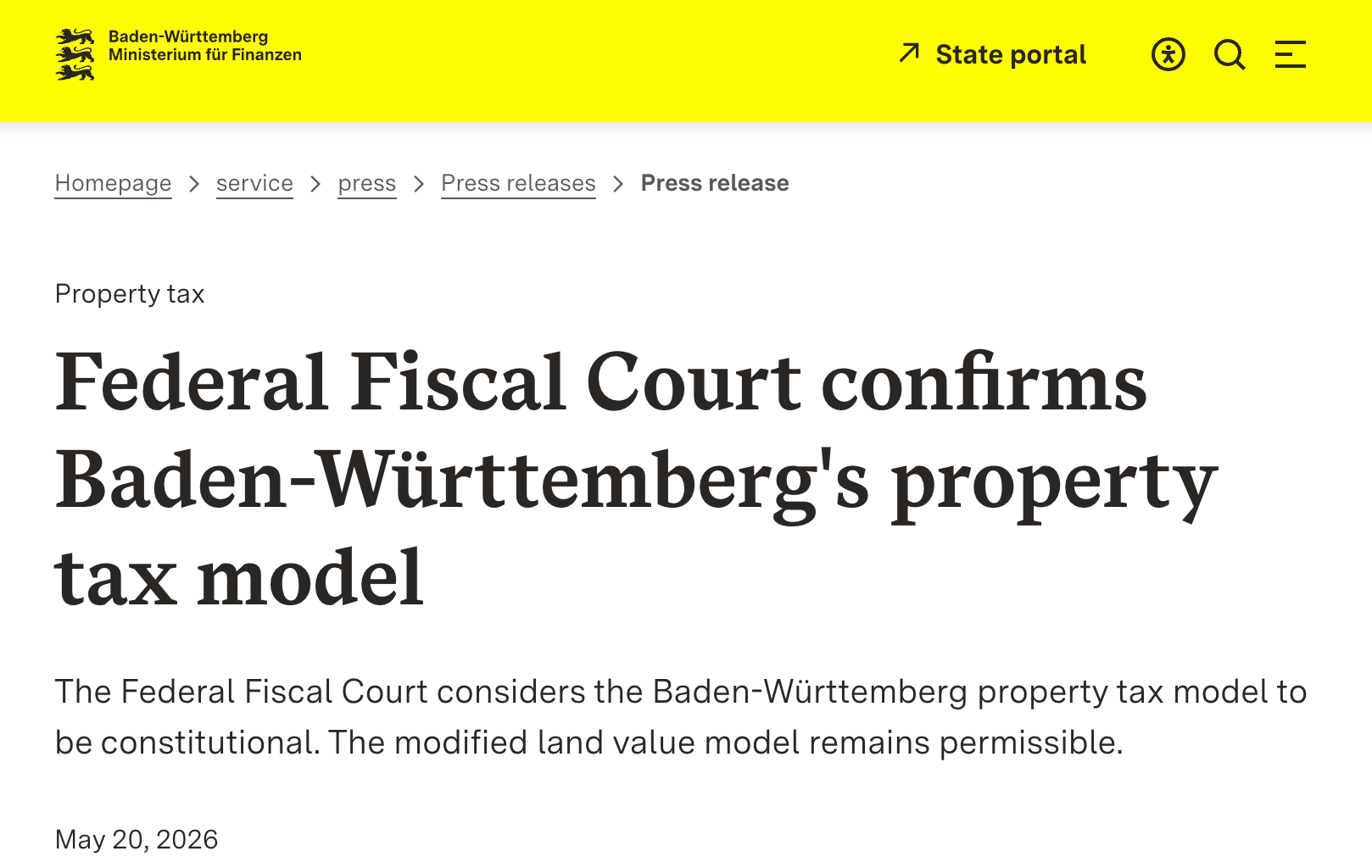
The international momentum continues. In Canada, a SaltWire op-ed made the case for a land value tax in Nova Scotia. And in Wales, the Green Party went all-in: their 2026 Senedd manifesto proposes scrapping council tax entirely and replacing it with a land value tax, shifting the liability from occupiers to owners, swapping business rates for a land-based system, and adding a vacant land tax for good measure. The Greens have a real track record here. In Germany, it was the Green Party that pushed Baden-Württemberg to actually implement one. When we interviewed Dr. Dirk Löhr about that model, it was still facing a constitutional challenge — and the results are now in: in May, Germany’s Federal Fiscal Court upheld Baden-Württemberg’s pure land-value tax as constitutional, throwing out the lawsuits against it.
Updates from the Center for Land Economics
Chicago: “Tax & the City”
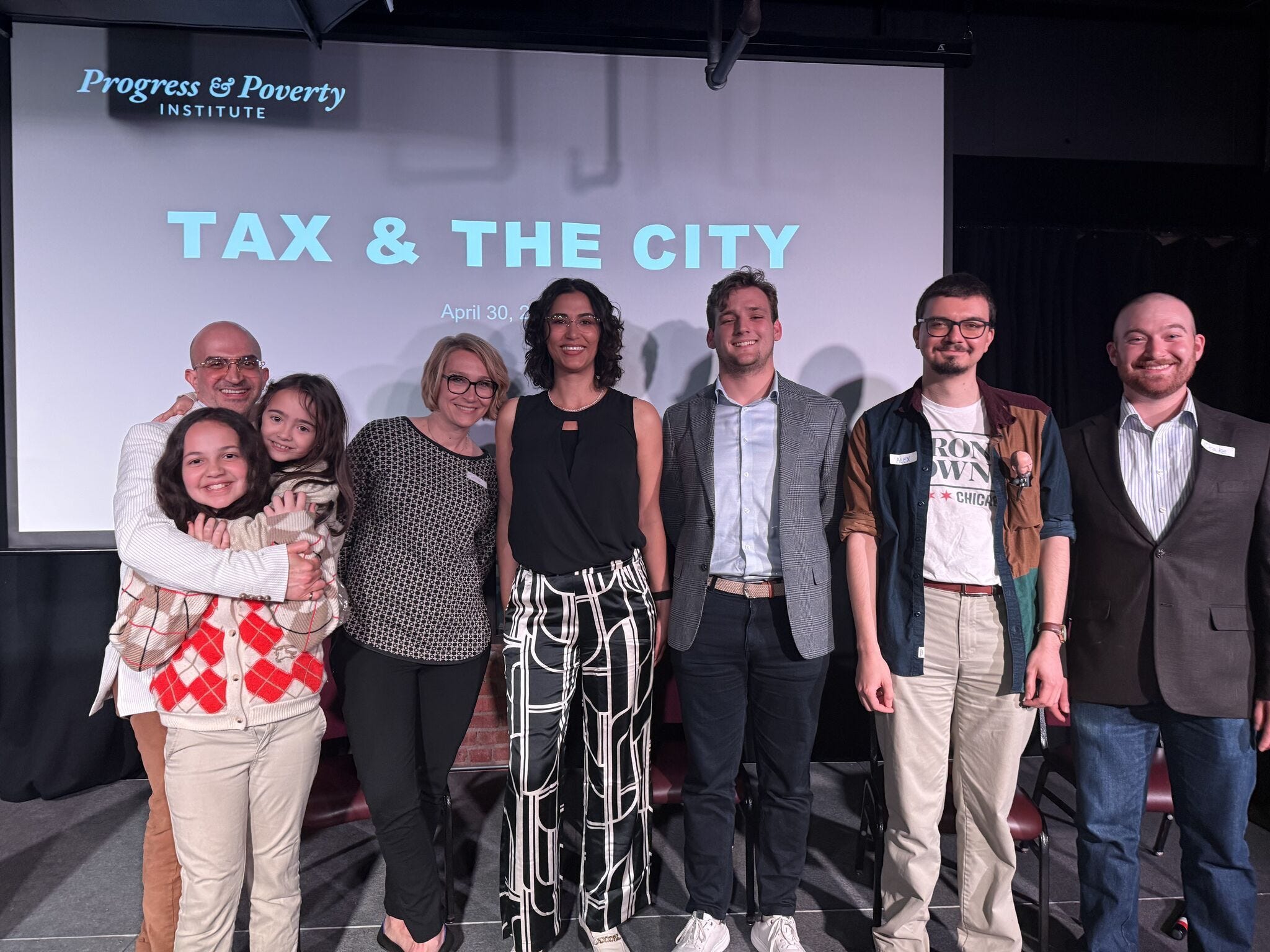
In early May, Progress and Poverty Institute put together an event, “Tax & the City,” which included Greg on the panel with Josie Faas, Drake Warren, and Daryl Fairweather. It capped a busy Chicago swing that also included a land value tax panel at the Urban Affairs Association conference. The full video is up here.
Strong Towns
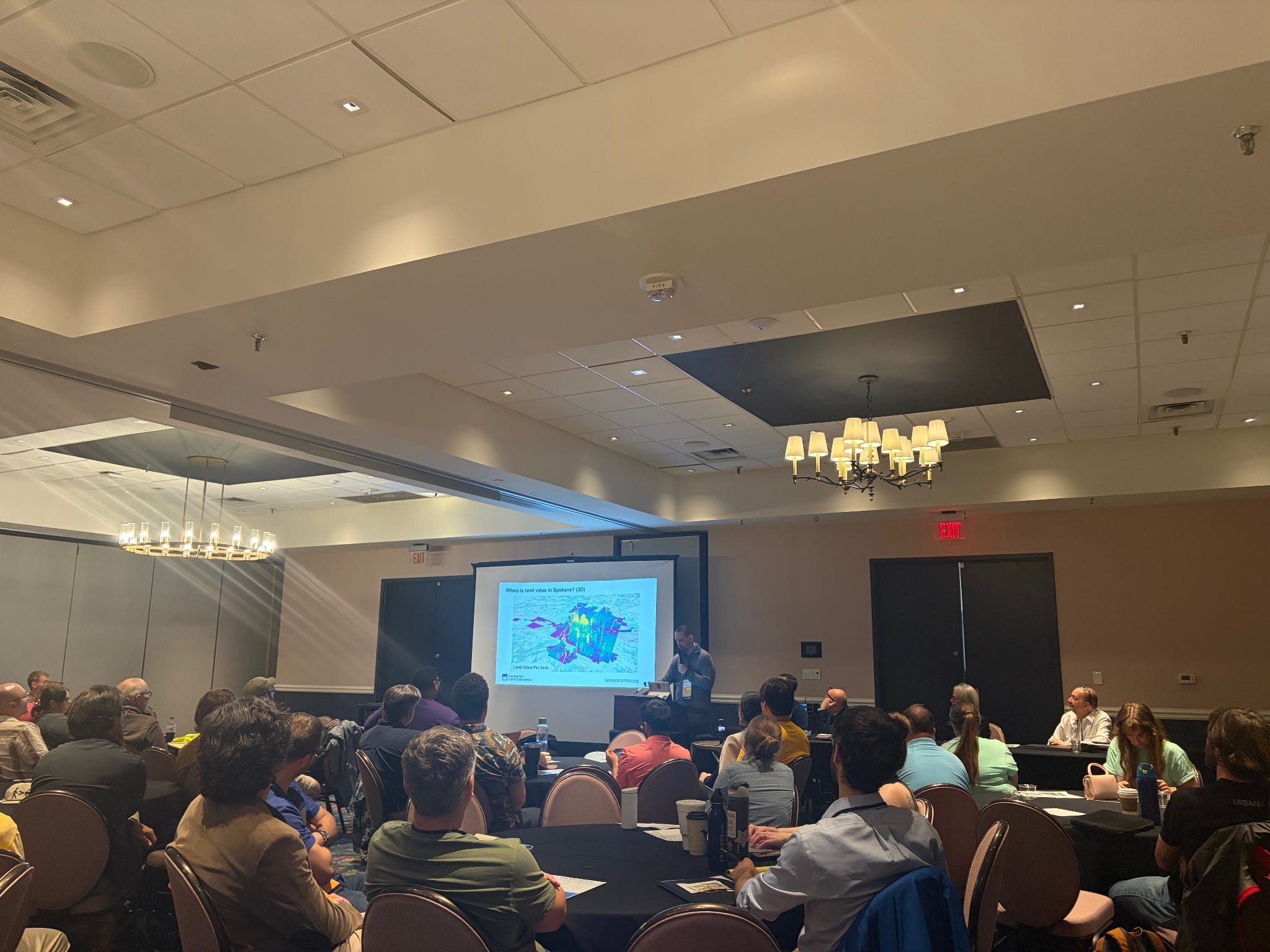
We were also out in force at the Strong Towns National Gathering, where Lars joined Josh Vincent, Sharon Suarez, and Joe Minicozzi for a land value tax panel. And two more Lars appearances worth your time: he was just on the Strong Towns podcast this week, digging into the housing crisis beneath the housing crisis, and he recently sat for a StrongTowns Q&A as well.
Lars on the UCLA Housing Voice Podcast
Lars also joined Shane Phillips on the UCLA Lewis Center’s Housing Voice podcast, one of the best ongoing conversations in housing economics in Episode 111, “Land Value Tax Would Fix This.”
Worth Your Calendar: A June 26 Talk on Philly’s Wage Tax and LVT
One event to flag, courtesy of our friends at the Progress and Poverty Institute, who are co-hosting it: on June 26, a recent Harvard PhD will present a job-market paper with an eye-popping finding — that replacing Philadelphia’s wage tax with a non-distortionary land value tax would pull 26,000 jobs from the suburbs into the city, with gains that triple once you account for productivity agglomeration. It’s a hybrid (virtual and in-person) talk; the virtual option is probably the easy one for most of you. Register here.
More LVT Coverage
Beyond the items above, land value tax keeps surfacing in more places than it would have even a year ago:
Redfin Chief Economist Daryl Fairweather put out a terrific ~20-minute explainer on the land value tax.
Liberal Currents argues yes, we can just tax the rich which lands, naturally, on land as the thing you can’t move offshore.
A companion piece from Liberal Currents, “Rent: a new framework,” reframes how we ought to think about rent in the first place.
On the Neon Liberalism podcast (#77), historian Christopher England asks whether a land value tax would fix it, a great primer if you want the historical sweep.
The Urbanist runs a clean explainer making the case for shifting to a land value tax by a local resident: Aaron Schechter.
Common Edge makes the design argument in “Back to Earth: The Case for Lowering Speculative Land Values.”
CEPR explains why LVT and progressive property taxes are two great taxes that go great together.
A fun bit of history from Cincinnati Magazine on when Cincinnatians led a movement to abolish all taxes except the one on property.
In Portland, Willamette Week readers weighed in on taxing vacant properties and more.
That’s it for Landscape 9. If you’re seeing movement on LVT in your area, reach out: greg@landeconomics.org.
Greg Miller is the Co-Founder and Executive Director of the Center for Land Economics.
Fun fact: being limited to 250 words in the Cap Times is why I started my substack. Rite of passage to have a letter clearly state the benefits of the thing you like and say "and this is bad". It will be sureal if Paul Fanlund does a column on it.
Impressive progress despite some expected headwinds.