
Land value taxes are winning: LVT Landscape Live
Video and transcript from our latest LVT Landscape LIVE


On June 3rd, 2026, the Center for Land Economics and the Progress and Poverty Institute teamed up again for the latest in our “LVT Landscape LIVE” series, where we update the community on what’s happening nationwide in land value tax (LVT) policy. This time we were joined by a panel of elected officials and advocates who have actually moved land value taxation forward on the ground — in Ohio, Kentucky, Virginia, and New York. Many people couldn’t make it live, so we’re glad to share the recording and the full transcript below. Many thanks to our partners at the Progress and Poverty Institute, especially Stephen Hoskins, and to all of the officials and advocates who joined us.
Here is the video in full:
The transcript below is lightly edited for readability, with slides from the presentation included throughout.
Video Transcript
GREG: Thank you all for joining us today. My name is Greg Miller. I’m the Director of the Center for Land Economics, which I co-founded with Lars Doucet, who’s also on this call. We’re here with Stephen Hoskins, who’s going to get us started. We appreciate you all joining.
STEVE: Good afternoon and good evening, everybody — and good morning to a former colleague of mine, Professor Sock-Yong Phang, who I think is calling in from Singapore. I’m Steve Hoskins from the Progress and Poverty Institute, where I work as the Director for Community Research and Engagement.
I’ll give a quick intro to today’s event and some admin, and then hand it back. You heard plenty from Greg and me at the previous LVT Landscape LIVE, so hopefully I won’t be doing too much talking tonight.
A few housekeeping notes. The meeting is being recorded and will be posted online early next week. Please stay muted for the event unless we open up the general Q&A at the end. You can put questions in the chat as we go, and I’ll collect them and put them to our guests. We’ll follow up with an email next week with the video link and any materials from this webinar.
Now for a few quick updates from the Progress and Poverty Institute side. Greg will show you a lot of the materials CLE has been working on at the end of the event. On our side, we’ve been reshaping our grant program this year to focus more heavily on LVT. As one example, Nathan Seegert is going to extend his implicit-land-tax modeling to do LVT-shift modeling on roughly two-thirds of the counties in the US. Russell Richie joined us a couple of months ago as Director of Strategy and Impact, and he’s been driving our networking and grant applications. We also have a big conference program rolling out for the rest of the year — the National Tax Association, IAAO, and YIMBYtown in particular — so we hope to meet many of you in person.
Where things stand: the national LVT landscape
STEVE: To pick up where we left off last time, the main argument we wanted to drive home was that land value return is needed, it’s pragmatic, and it’s achievable.
It’s needed because America has a record number of rent-burdened households, a severe shortage of housing where it’s needed most, and rising wealth inequality, much of it driven by land.
It’s pragmatic because we’re seeing very high levels of interest in LVT right now. That’s a combination of those problems and of local communities bracing for the retreat of federal support and looking for new local revenue to fund municipal and state services.
And it’s achievable, which is what we’re really highlighting today. We’re seeing a lot of enabling legislation on the table, growing interest in implementation, and some real wins.
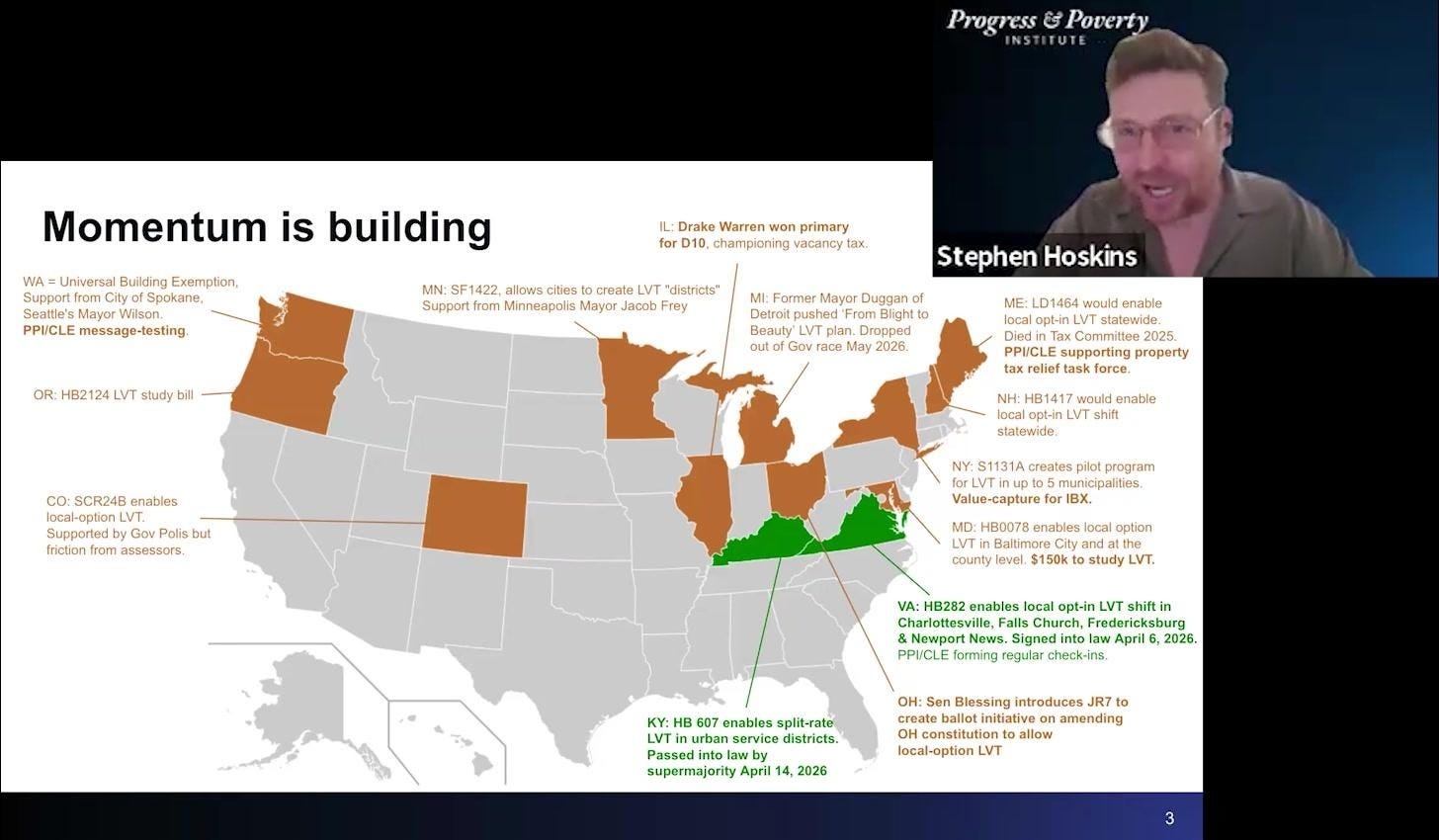
This map highlights the states with active LVT legislation, recent legislation, or movement we expect soon. The green states are where there have been wins, and we have guests from several of them tonight.
A few specifics. In Illinois, Drake Warren — who spoke at our previous event — won his primary and is the presumptive Cook County Commissioner. He spoke at an event we hosted in Chicago last month, and he’s expected to push for a vacancy or underutilization tax in Cook County, which is mostly a function of the constitutional constraints there.
In Virginia, you’ll hear from Lyle Solla-Yates in a moment about the legislative win. We’ve also funded Joh Gehlbach and Angela Tiangco of YIMBY Action to study LVT shifts in Virginia and work on policy design, and PPI and CLE are about to start regular monthly check-ins with on-the-ground advocates there.
In Maine, Greg, Lars, and I have been serving as analysts for the state’s task force. I’d frame a lot of that work as defending the integrity of the property tax system from the kind of tinkering that erodes its efficiency.
In Maryland, $150,000 has been allocated to study land value capture within a half-mile of transit.
And in Washington State, where I live, there’s real interest from Spokane and from Seattle’s mayor. We’ve signed a contract supported by the Sightline Institute to do LVT message testing — finding ways to frame the policy so it’s understandable and appealing to local voters.
I won’t say more about New York, Virginia, Ohio, and Kentucky, because that’s where our guests are from. So I’ll hand it over to Greg.
Meet the panel

GREG: Thanks, Steve. That’s helpful context. On the Progress and Poverty Substack, you can find the December event that lays out why we think land value tax is having a moment. We covered a lot last time, so today we’re really excited about this panel — a strong group you’ll hear from over the next 40 minutes.
We’ll start with Senator Blessing, who will talk about his work pushing LVT in Ohio. In typical fashion, he’s calling in from just outside a colleague’s fundraiser. Then we’ll hear from two people who have helped pass legislation on the ground, and finally from Reed, who is doing innovative work on land value capture around transit corridors in New York City. If you follow this movement, you may have seen his report last week on the Interborough Express corridor.
I’ll pass it over to Senator Blessing.
Ohio: fighting property-tax abolition with a better idea
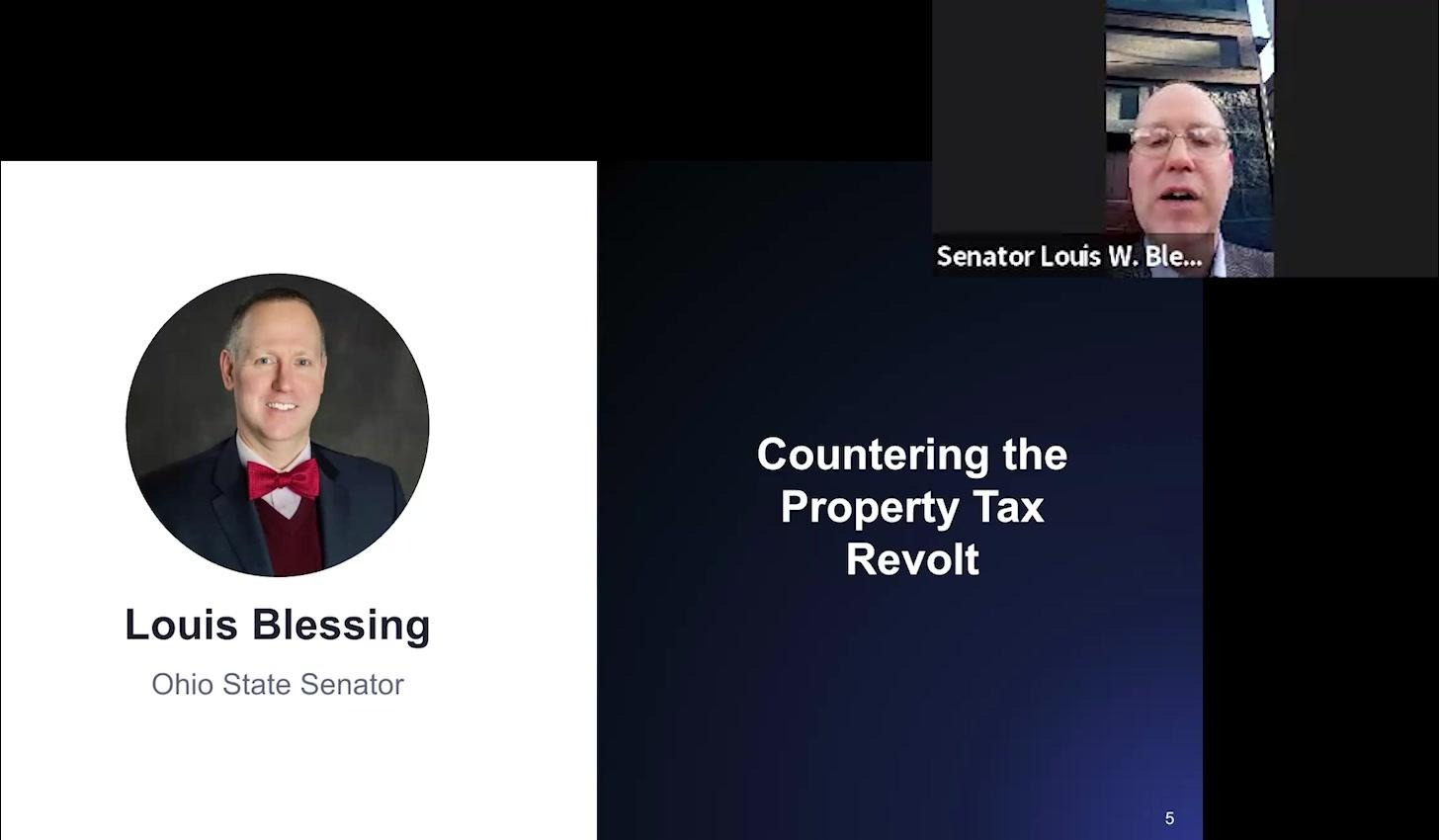
SEN. BLESSING: Thanks. As Greg said, I’m actually at a former colleague’s fundraiser — the former Senate President, now Speaker of the House, Matt Huffman — and I’m a couple of blocks down from it.
I’m glad we’re talking about the property tax revolt. As you may know, in Ohio we have a potential ballot issue. They haven’t gotten the signatures yet, but they have until July to put a total property-tax-abolition amendment on the ballot. This isn’t like Prop 13 in California or other measures that freeze property taxes at purchase. This is a full-blown “property taxes won’t exist anymore in Ohio” proposal, and it’s hard to put into words just how catastrophically bad an idea it is.
I’ve had a lot of success going around and telling people the damage it would do. For starters, Ohio’s property tax funds local government — townships, cities, villages, counties, and above all school districts — to the tune of $24 billion every fiscal year. To replace that, we’d have to roughly double the sales tax, more than double the income tax, and look under every couch cushion: the commercial activities tax, the financial institution tax, higher sin taxes, you name it. And we’d still struggle to fill the hole. But, as they say on TV, wait — there’s more.
What gets lost is that these folks assume that’s the end of it. I’ve warned them repeatedly that if you do this, you’ll get exactly what Winston Churchill warned about, what Henry George warned about, what many economists have warned about: land hoarding. I joke with my wife that if this passed, I’d immediately buy 30 or 40 acres in my home county, because I could sit on it tax-free forever. That makes land even scarcer, drives up real estate prices, and slows development to a crawl as everyone has to pay these land-hoarding middlemen.
For all the seniors who think they’ll make out well, consider that property taxes can actually make housing more affordable precisely because they’re such an efficient funding mechanism. Take them away and insurance costs go through the roof, as they have in Florida — and Florida hasn’t even abolished property taxes; DeSantis has only proposed cutting them back.
The net effect is less housing, which Ohio can’t afford — we’re about a million units short. A young person trying to start a family would be doubly, triply, quadruply squeezed: maybe you’re not paying property tax, but your mortgage, insurance, income taxes, and sales taxes all go through the roof, and you get nickel-and-dimed everywhere else. I’ve argued it would be like a meteor hitting Ohio — an extinction-level event for the state.
So when people ask what we’d put on the ballot instead, I say: don’t threaten me with a good time. I’d put up SJR 7, my constitutional amendment to allow land value taxes in Ohio. I listen to some of the folks speaking after me who can do this reform today, and I think, my God — you’re already running the race while we in Ohio are still in bed because of our constitutional prohibition.
A lot of my colleagues are interested. I tell them, look, I’m a Republican; I get that this reads as a progressive idea, though it’s classical progressivism. Don’t get it tangled up in social issues. It simply says you don’t pay tax on improvements — and when you don’t tax improvements, you get more of them. It’s the most efficient tax there is, and we’re leaving our best player on the bench because of a constitutional prohibition. That argument lands well; they understand it.
The hang-up has been colleagues who want to pair it with property-tax and income-tax cuts and send everything to the ballot. My response is that if you simply let local governments adopt this by majority vote — while they still have to send property and income taxes to the ballot — they’ll organically shift toward the land value tax and leave the other taxes alone. Why bother with a ballot fight otherwise? In theory, the net effect is more prosperity, because you’re moving from punitive taxes to an efficient one.
This has actually worked. Republican members in both the Senate and House have come forward wanting to do companion legislation. The challenge is that after our big property-tax fight last December, there’s some fatigue with real estate taxes generally. But I’m very hopeful, and I think a lot can be invested in Ohio here.
If I’m ultimately unsuccessful — the polling on land value taxes can get a little weird — I still think reform can work. Ohio is one of those states where, if push came to shove, we could gather signatures and take this to the ballot. I don’t think you’d see the same opposition you’d get on other issues. Based on my research, progressives come out for it and conservatives come out for it. A local woman once complained to me that she’d bought a house, fixed it up, and watched her property taxes jump at the next valuation. I told her: guess what wouldn’t happen under a land value tax? Exactly that. It would have stayed flat — or only gone up if the locals voted for it.
So even though Ohio has to clear the constitutional hurdle, there’s a lot of good energy here, across the business community, the conservative world, and the progressive world. It hasn’t gotten much traction lately, but that’s about logistics and other pressing issues in the General Assembly, not the idea itself. That’s my TED Talk — I’m at about ten minutes, so I’ll yield to the other speakers.
GREG: You landed on ten minutes almost exactly. For those who haven’t seen them, go online and watch Senator Blessing’s many interviews on this issue. There’s an “abolish the property tax” movement out there — Florida just held a three-day emergency session on it this week. Reframing this as abolishing the tax on buildings to encourage development is powerful: we’re about to hear from a Republican state where Republicans passed legislation, so this is genuinely bipartisan. I love Senator Blessing’s line about leaving our best player on the bench. Every economist agrees land value tax is the best tax — including Milton Friedman — so why are we benching it?
We’re working with Senator Blessing on LVT modeling for Cincinnati to build more momentum there. Now I’ll hand it to a local advocate who isn’t elected but works directly with electeds, and who helped pass legislation in Kentucky in about six months.
Kentucky: a split-rate win in six months
JACKSON: Hi, everybody. I’m Jackson Arnold, a citizen member of the Abundance Network here in Louisville, Kentucky. The Abundance Network is a national organization of members — elected officials, donors, and citizens like me — who work together to get abundance-related policies off the ground in states and cities across the country.
I joined about May of last year and was immediately connected with another member here in Louisville, Councilman Ben Reno-Weber. From the start, we looked for a project where I could do the heavy lifting on data and policy and he could fight for it politically once I had the evidence. The first thing we settled on was vacant and abandoned properties. I knew about land value tax as a concept, and I knew it was illegal in Kentucky, but I came to the conclusion that one of our biggest policy openings was getting some form of land value tax activated here in Louisville.
So today I’ll talk about how we did it, how I think about land value tax and the abundance movement working together, and some tips for repeating this in your own city or state. For those who don’t know, abundance is a growing national movement about building more — more housing, energy, and transportation — to reach material abundance for everyone. I think an LVT hits most of those goals squarely.
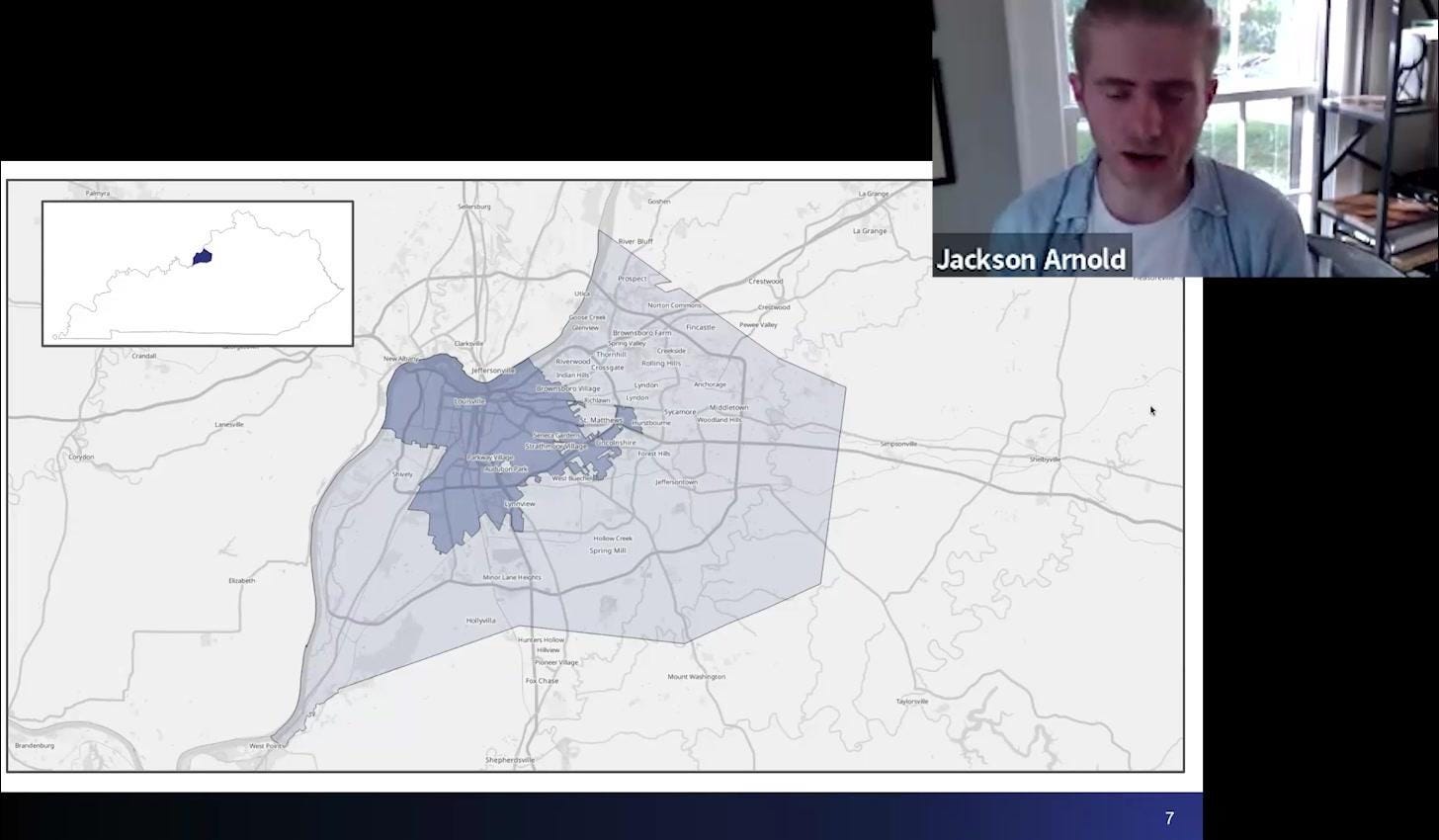
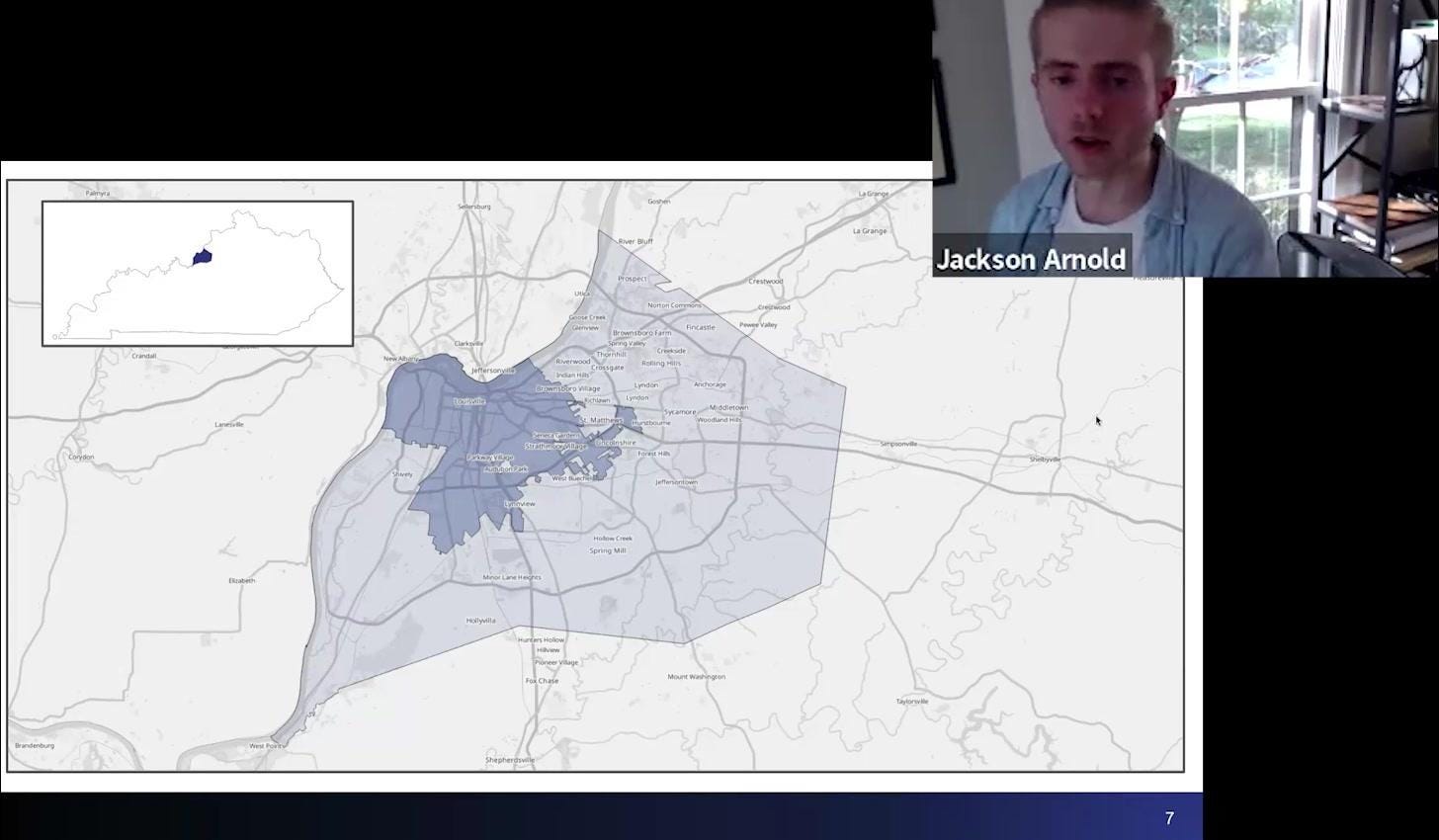
Greg is showing a map of Louisville, which is Jefferson County, Kentucky. For context, Louisville is a combined city-county government, so Louisville and Jefferson County are governed by the same jurisdiction. The councilman I work for is one of 26 on a Metro Council with a Democratic majority and a Republican minority.
Once I had the evidence to show that LVT could be a valuable tool for our vacant-and-abandoned-property problem — like most Midwestern cities, we have a lot of vacant property in our inner city, particularly in historically redlined areas — I did a preliminary legal and data analysis to figure out what implementation might look like and what we’d need to pass it. On the legal side, it’s complicated, but the short version is that constitutionally we can do a split-rate tax but not a full land value tax. So we still have to tax buildings somewhat, and we need the local legislature to enable it.
I brought these facts to Councilman Reno-Weber, who was excited, partly because it would also help with one of his pet issues: downtown parking lots, of which we have plenty. As I refined the analysis, he started talking to other council members. The first he found was Councilman Andrew Owen, who had discovered the policy around the same time I was pitching it, and who was interested for the same reasons we all were. He then connected me with Councilman Anthony Piagentini, the chair of the Republican minority on Metro Council.
For those who don’t know, Kentucky is a red state despite our Democratic governor, with a Republican supermajority in the legislature. If you want something done, you have to get them on board. As luck would have it, the Jefferson County Republicans were already working on a bill to reform how Louisville’s city government works, which meant we could slip a provision right in.
I was pushing for a reform to one of our county property taxes. We have three: a metro property tax for the whole county, a countywide school tax, and our Urban Services District tax. The darker shaded area in the center of this map is the Urban Services District — the historic boundaries of the City of Louisville before the merger, where the city provides services like trash pickup and snow removal that aren’t provided elsewhere, funded by a separate property tax. That district turned out to be exactly the target we needed to get Republicans comfortable, because they’d have been nervous about affecting their own voters.
In general, Councilman Piagentini was very supportive, because a lot of his exurban voters — and his colleagues’ — are tired of sprawl: more suburban development, more traffic, and disruption of the large landholdings they value out in the county. They want more development downtown to take the pressure off, and inner-city Democrats want more development too. So we struck a bipartisan deal — me and three council members — to push this into the state legislature under the Republican-led bill.
That bill was essentially an omnibus, with a lot of other provisions, so Democrats pushed back on the whole thing, but the property-tax piece was popular. Representative Rachel Roarx, one of the Democrats most opposed to the bill overall, made a point of saying on the floor that she appreciated the property-taxation changes, which she thought could benefit Louisville Metro. Despite Democratic opposition, it passed the Senate and the House, got vetoed by the governor over the other provisions, and was almost immediately overridden in both chambers. As of April, Louisville has legal permission to implement a split-rate property tax in its Urban Services District.
That’s more or less the story. We’re now working out exactly how to implement it, because there are real technical and procedural challenges once you actually have the authority. But things look promising, and I expect more news on this front in the next couple of years.
Honestly, getting it done in six months was a momentous achievement, and we were also extremely lucky — we were in the right position politically at both the city and state level. We also have a housing shortage: the mayor wants to build 15,000 units, and we’ve built 7,000 toward that goal, so we have to work hard to beat the shortage. But once that energy fades, we’ll still have a tax system that lets us keep at it over time.
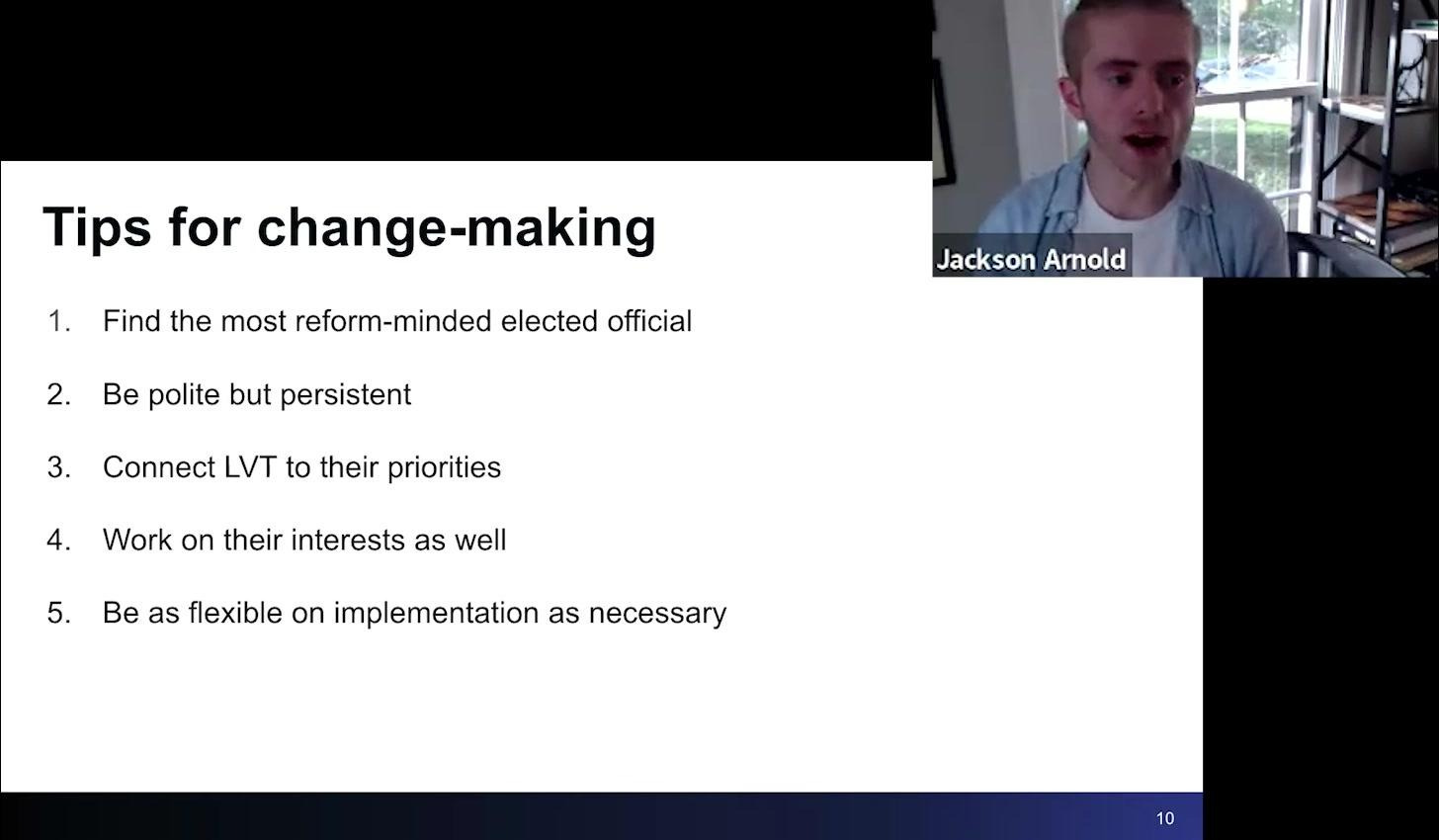
To finish, here are some lessons from this six-month process.
First, if you’re working alone or in a small group rather than a big grassroots movement, find the most reform-minded elected official you can and stick with them as your voice. A local legislature is ideal, because those offices don’t have large staffs, so you can be a resource they can’t otherwise get if you volunteer your time and expertise.
Second, be polite but persistent. These are busy people who will say no a lot or ghost you, but if you don’t take it personally and you keep at it, you’ll eventually find an opening.
Third, connect LVT to the elected official’s own priorities. That’s how you get them to genuinely champion it rather than offer a milquetoast “sounds cool.” Even better, help with their other interests too, so you’re not a single-issue, LVT-obsessed advocate — you care about reform broadly, and they’ll be more likely to care about the reforms you care about.
Finally, be flexible on implementation. We just need wins on the board, and any win counts, however small. The area now legalized for LVT is a tiny share of the state, but it’s one of the most impactful, because it’s where most of the land value is. Give where you have to, but keep the core of the policy alive. Thank you, everybody — and thank you, Greg, Lars, and Steve Roseman.
GREG: Thank you, Jackson, for leading a successful effort. When he says he got lucky, he found the right political opening — but he didn’t just get lucky; he partnered with the right people and stayed flexible. That’s the takeaway in politics: be normal, be approachable, and be helpful, and you can find the opportunity. The opportunity doesn’t always come, and many people on this call have been working on this for decades, so there’s real work to do — but it’s not just luck.
Jackson also mentioned that implementation matters. Lyle knows this well, working for the city government in Charlottesville and helping lead Virginia’s enabling legislation, which passed about a month ago. I’ll hand it to Lyle to talk about the experience in Virginia.
Virginia: from years of losing to a signed law
LYLE: Great. My name is Lyle Solla-Yates. I’m a Planning Commissioner in Charlottesville, Virginia, and I teach zoning at the University of Virginia. I spend a lot of time looking at maps and worrying about what they mean and how they could be better. It’s hard to get the rules right and it takes years, but I’ve been at it a long time, which helps. We completely overhauled our zoning with a new comprehensive plan and housing plan, and we spend $10 million a year on affordable housing — more than any locality I know of except Washington, D.C. That’s a big deal.
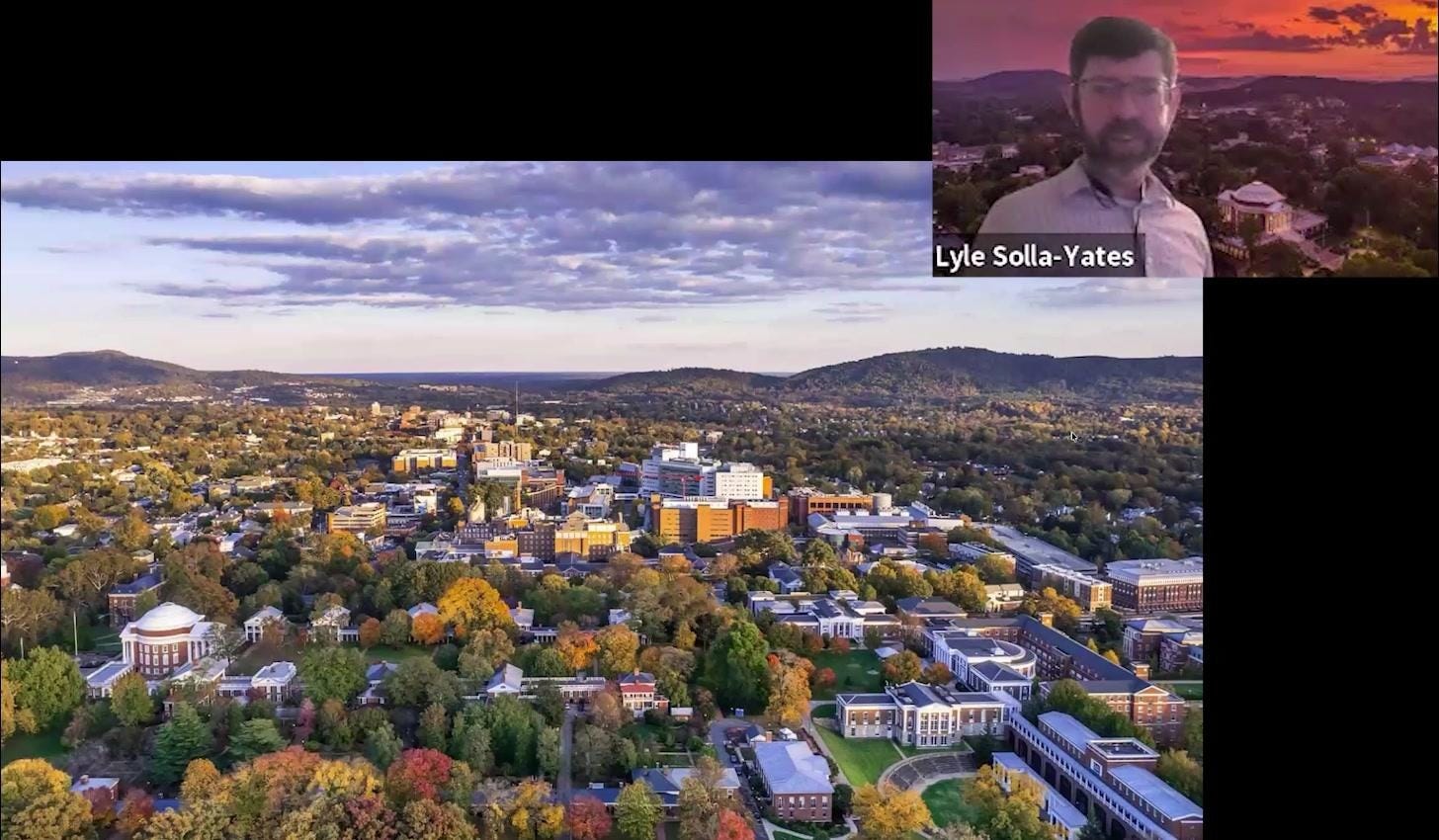
Charlottesville looks like this on a nice day: the University up front, the West Main area, downtown, the hospital — that big building on the right — and beautiful mountains behind. You’ll notice there aren’t many big buildings, and a lot of green, which is lovely. But I wouldn’t call us rich.
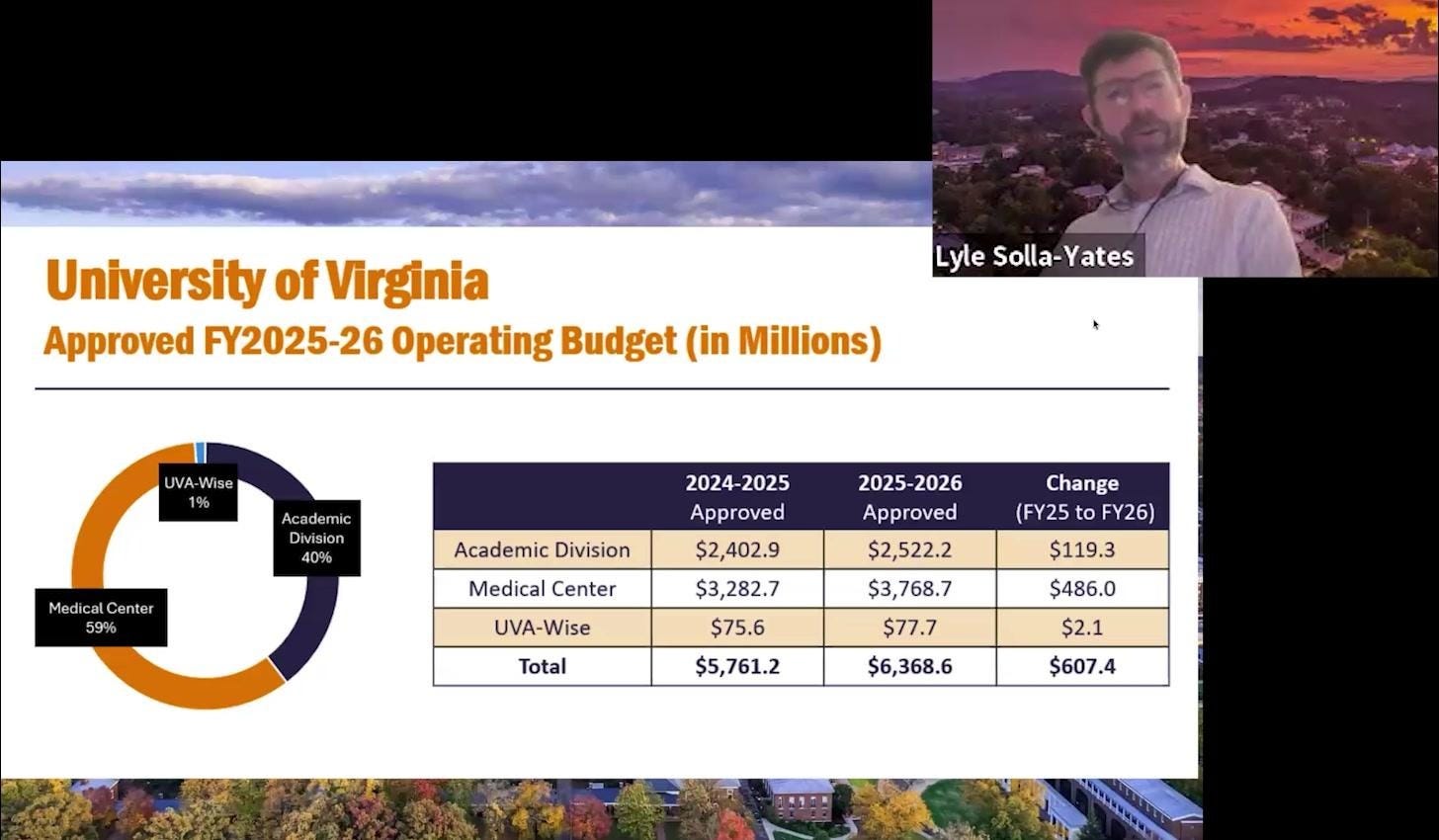
The University of Virginia, my main employer, pulls in about $6 billion a year, so expectations here are high — we compare ourselves to Paris, London, and Tokyo. But the city doesn’t have that kind of money. We have millions, which is good and not nothing, but it’s not enough for the level of services people expect. There’s a big gap between our dreams and our abilities.
So we make do. What I’m best known for is the Charlottesville Plans Tomorrow program — the new comprehensive plan, affordable-housing plan, and new zoning to allow the kinds of affordable housing we’d previously banned. As part of that, we adopted $2 million a year in tax relief — not tax abatement, tax relief — plus $10 million a year in affordable-housing spending. That’s $12 million a year, and the question is where the money comes from.
So far we’ve spent $59 million, which is more than we expected. It means we’re putting off other things we want to do, especially school spending and transit. And we’re raising taxes to pay for it, which people absolutely hate.
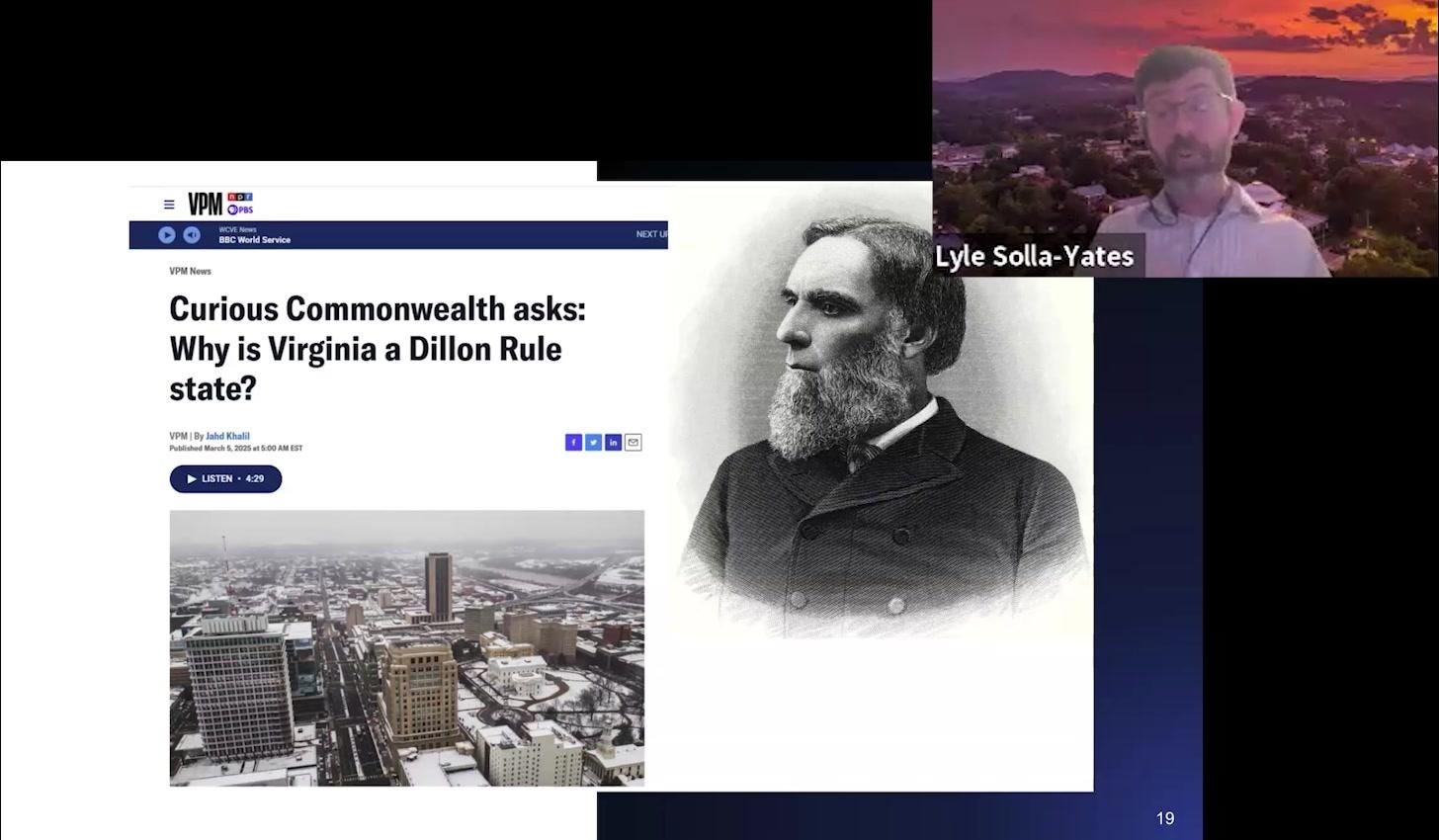
The reason our hands are tied is that Virginia is a Dillon Rule state: localities can only do what the legislature explicitly allows. That’s because of the gentleman on the right — I don’t think he meant to hurt Charlottesville specifically, but he did. So if you want to do anything, like a land value tax, you have to go to Richmond and ask. That’s what our friends in Roanoke and Fairfax did.
I got interested in this from Roanoke City Councilor Bill Carter, pictured here, who recently passed away. He was the guiding light behind the restoration of downtown Roanoke, and what he did with his career was incredible. He was a Republican, but he was really a Georgist, and he got the legislation through and got me interested.
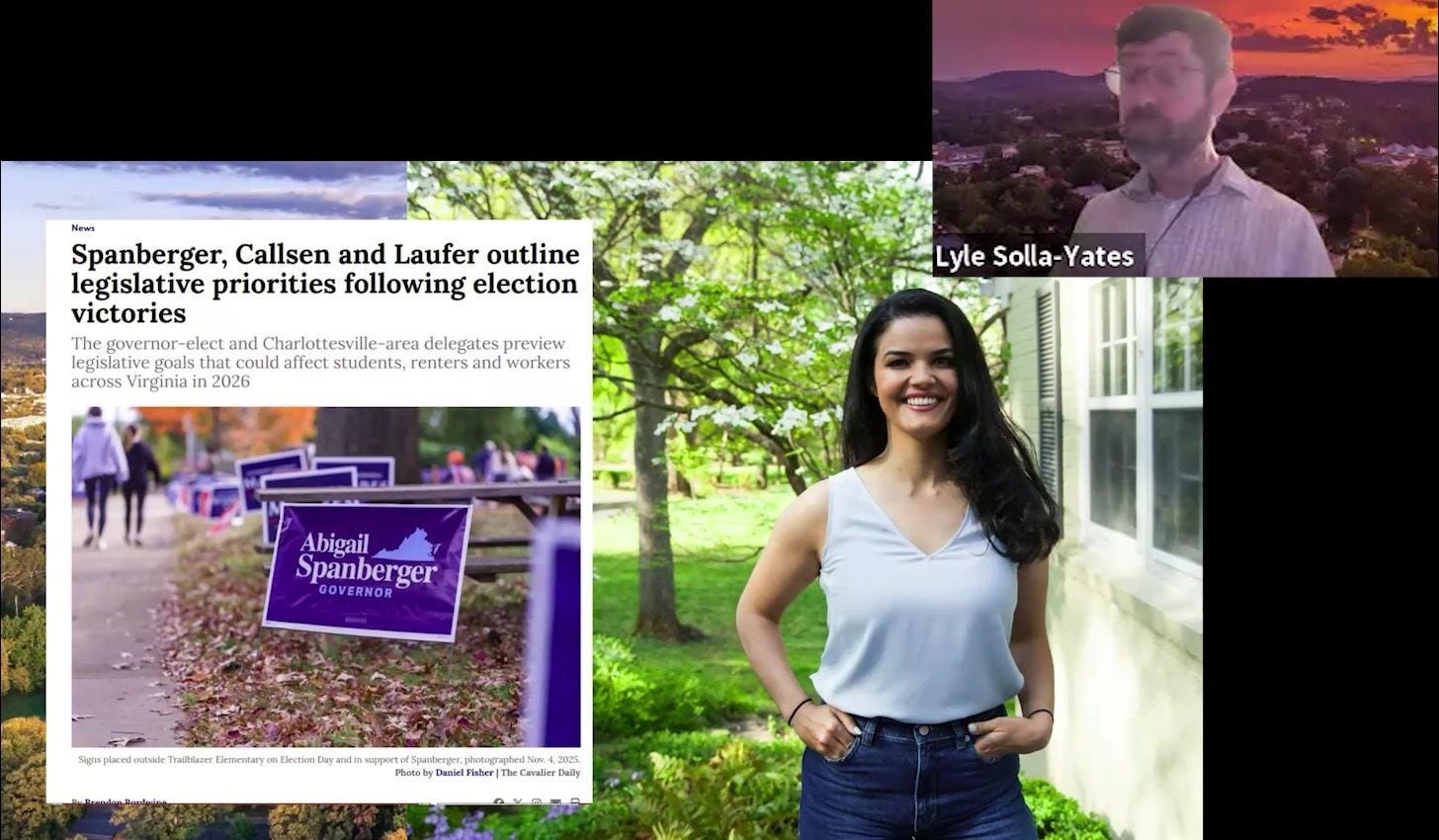
This is Mayor Nikuyah Walker of Charlottesville, who ran on equity and fighting displacement. Working with her is how we got the $2 million a year in tax relief done — a big lift that meant cutting popular things. But it’s in place and ready to go.
Our friends in the nonprofit community built an analysis of how a tax shift to land value would actually work in Charlottesville, parcel by parcel. The data is old now, but at the time it was vital: if someone worried about a specific parcel, I could tell them precisely what would happen to it.
One day, Delegate Sally Hudson walked up to me at a giant parking lot and said, “Lyle, you’ve done so much for the city. Is there anything I can do to make things better?” I said, “Land value tax, obviously” — that’s what you say whenever an elected asks. She said, “Sure, I’m an economics professor, I know a bit about that.” Joe McNamara, pictured on the right, is a CPA. An economics professor and an accountant walk into the state legislature — and they get absolutely wrecked. For years, every single time, we lost on a party-line vote. The party in power kept changing, but whoever was in power was against it. It was maddening.
But then an election brings new faces and a new governor, and things change. This is Katrina Callsen, the new delegate — not an economist, but a lawyer; don’t hold that against her. She gave me five minutes. “Lyle, what can I do?” I said I had one idea. She took it forward. It didn’t go well at first, but we regrouped, worked with other localities, and combined four separate bills into one to give everyone a chance. Governor Spanberger signed it. She vetoed a lot of other things, so this was no guarantee, but it went through. We now have the power starting in July. Very exciting.
This raises a lot of questions and opportunities. I met with staff today about how to start. There are plenty of question marks, but I’m hopeful we’ll begin soon.
GREG: Thank you so much, Lyle. He’s been key to translating these ideas into things cities care about, while staying attentive to administrative priorities and implementation. You heard from both Jackson and Lyle that the homework matters — the data analysis, the storytelling, the tax-shift explorer — because that’s the work that does the legislator’s job for them. Most of our electeds don’t have significant staff. As Jackson said, that’s exactly why a city elected is a good target: they don’t have a big staff, they have a hundred priorities, and their number one job every year is balancing a budget they can’t balance. That’s why our work matters.
Now we’ll pivot to something a bit different from passing legislation: capturing value for transit, which many on this call have thought about for decades. Cities invest enormously in themselves — how do we recover some of that value? I’ll pass it to Reed Schwartz, an Associate Fellow at the Institute for Progress, who recently published a report on exactly this.
New York: capturing land value to fund the Interborough Express
REED: Thanks, Greg. I work on infrastructure policy at the Institute for Progress, an innovation policy think tank, and I’m going to talk about a report I wrote for the Niskanen Center with Alex Armlovich, a non-resident senior fellow there. It’s about a newly reauthorized provision in New York State that could enable literally billions of dollars in land value taxes to fund transit.
To set the stage: New York State’s 2027 budget includes big plans for capital expansion. The highest-profile project is the Interborough Express, a line between Brooklyn and Queens — the city’s first end-to-end transit line since roughly the 1930s. But despite the current good feelings between the Mayor of New York and the President, federal transit funding has been precarious. Fortunately, the state budget just signed by Governor Hochul reauthorized Section 119-r of the General Municipal Law, which had expired in April and could provide a substantial new source of transit funding.
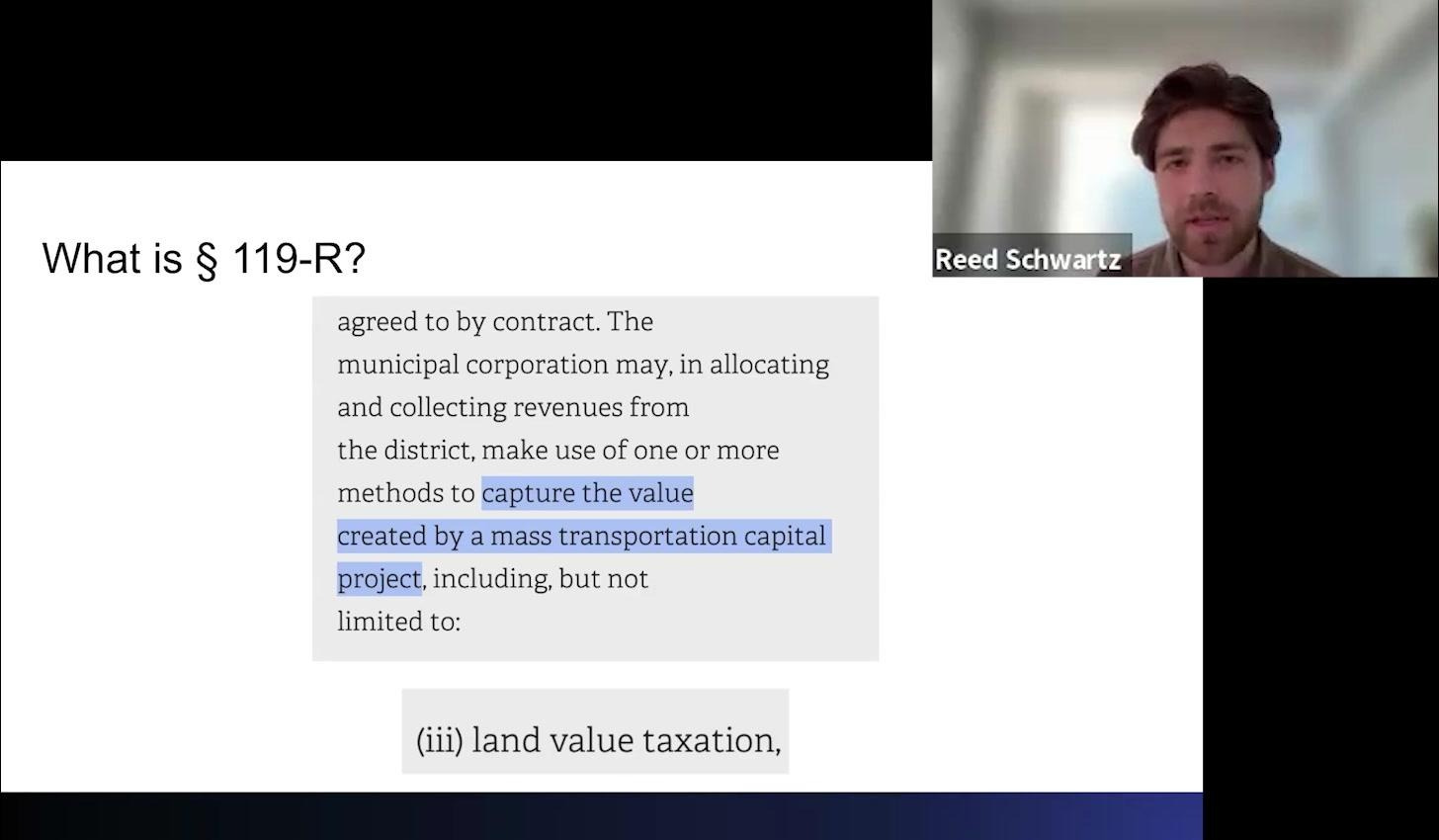
In short, 119-r lets cities in New York establish land value tax districts — as well as general property tax districts and tax increment financing with the MTA — to capture some of the value created when the MTA builds new transit. As you can see, it explicitly names land value taxation.
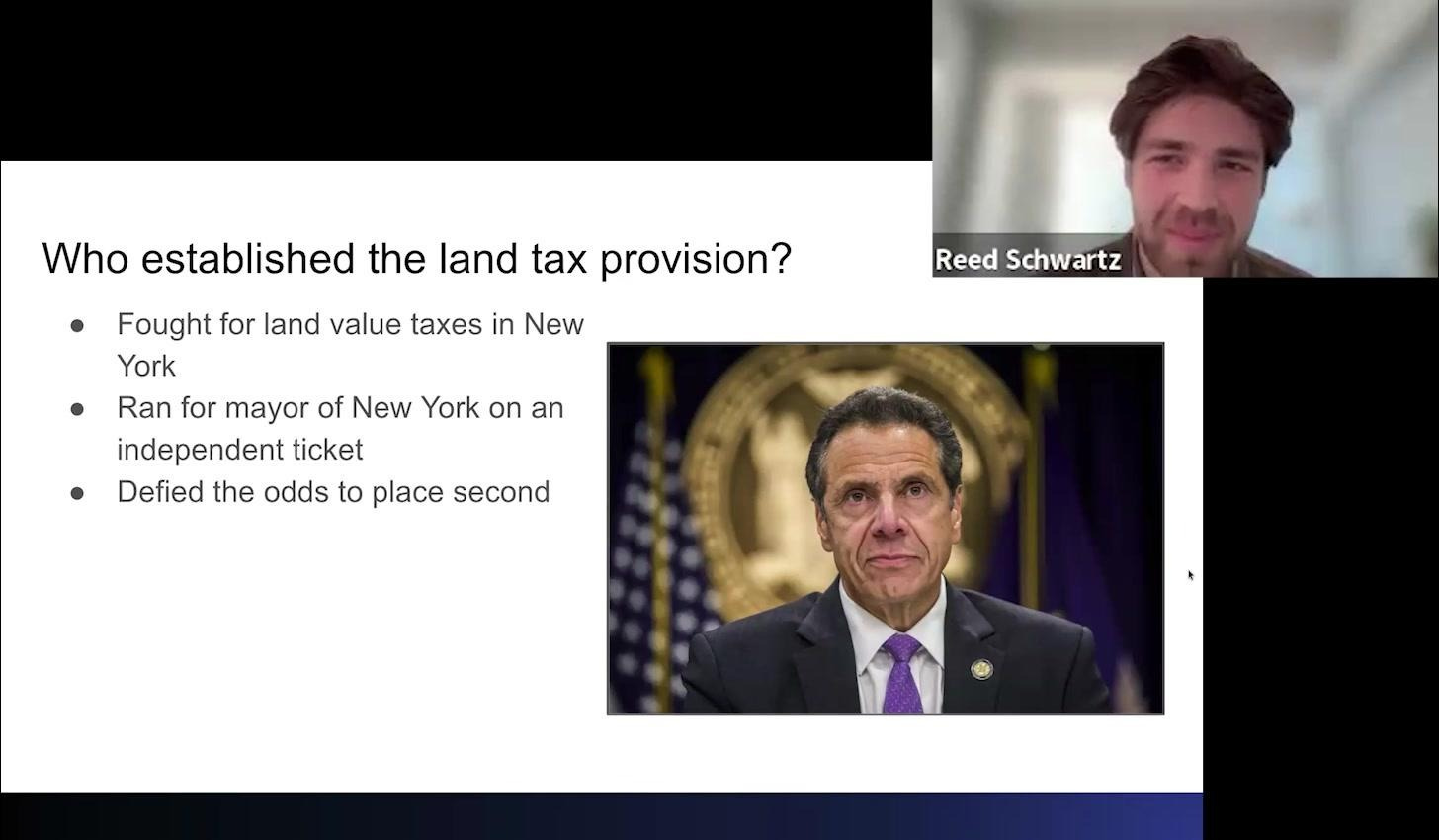
A bit of history. You probably recognize this figure: he fought for land taxation in New York, ran for mayor as an independent, and came in an unlikely second. I’m talking, of course, about Andrew Cuomo, who passed this provision in 2016.
This isn’t the first time value capture has funded projects in New York City. Under Mayor Bloomberg, the Hudson Yards development was financed through tax increment financing — essentially borrowing against the future property tax revenue the project would generate. But because of value exactions added since then, especially inclusionary zoning and prevailing-wage rules, the uplift from simply upzoning the Brooklyn-Queens corridor probably isn’t enough to fund significant new transit. The land value uplift from new transit access, though — connecting properties to firms, people, and other transit lines — could be much larger.
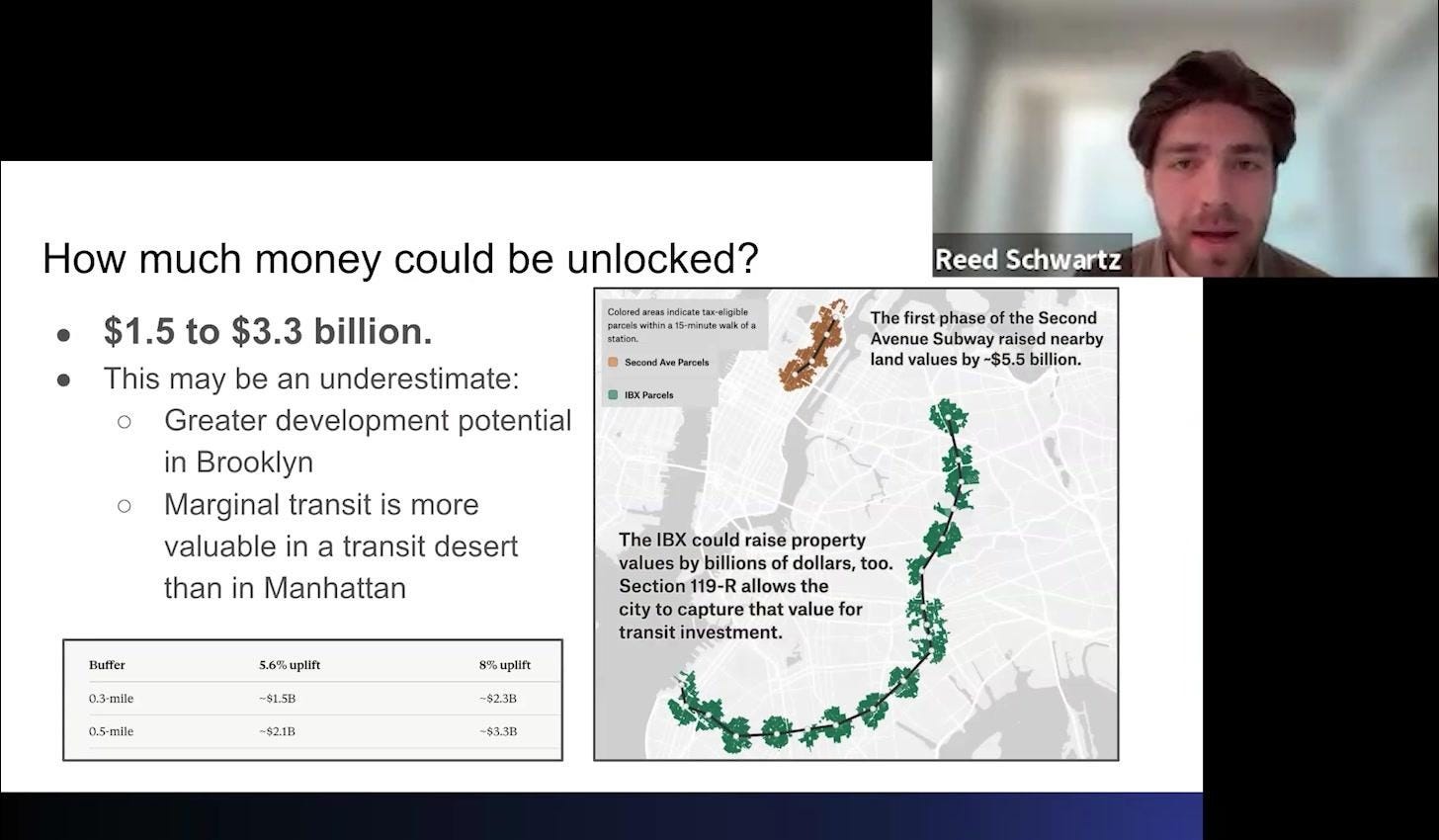
Value capture is, in general, a well-suited tool for transit funding. It places the cost of infrastructure directly on the greatest beneficiaries — the people who live near it and, more importantly, own land near it — rather than on poorly targeted sales taxes or fares. It can create a flywheel: revenue funds more transit, which generates more value, which funds more transit. It also encourages fiscal discipline, because it ties costs to benefits and pushes planners to ask which projects will actually generate a return. And it’s well tested: New York’s original streetcar lines were built partly on private value capture, with developers buying up undeveloped farmland, building lines out to it, and capturing the value they’d created by flipping the land. Hong Kong’s MTR funds itself partly this way too, so it’s well established internationally.
A 2022 study by Arpit Gupta at NYU looked at the Second Avenue Subway extension and found it raised nearby land values by $5.5 billion on a cost of $4.5 billion. That project was famously one of the most expensive in the world on a per-mile basis, and it still generated a huge social return. Some of that was captured through existing property taxes, but about 70% remained in private hands; the city ultimately captured only about 30%.
To estimate the uplift from the Interborough Express, we applied Gupta’s multipliers to New York’s existing property valuations and found a range of roughly $1.5 to $3.5 billion. There are reasons to think that’s an underestimate — Gupta’s multipliers run between about 5.5% and 8% depending on the corridor, there’s greater development potential in Brooklyn and Queens, and the line runs through transit deserts where new access is especially valuable. There are also reasons it could be an overestimate, given how productive Manhattan land already is. To be clear, it’s good that some value stays in private hands, for political-economy reasons — landlords supporting a project is helpful — but it probably doesn’t take a $3 billion transfer to landlords to win support for a transit line. Some of that should go toward paying for the line itself.
The budget that passed last week reauthorized the land value tax, but the City Council still has to authorize it and the mayor still has to sign it. We’re hearing good things from the state and the MTA, and there are strong signs the mayor himself is on board: back in 2022, when this was very low-salience, he gave an interview in Jacobin praising the provision and saying he wanted to expand it. He also introduced a bill to renew it and remove its sunset clause; as it stands, it expires next year if not renewed, although districts that are created won’t expire. You can read the report by searching “Niskanen IBX,” and I’ll drop the link in the chat. We’re optimistic, and Greg will keep you posted.
GREG: Thanks, Reed. Another case where doing the work and understanding implementation really matters, so keep an eye out for updates. I’m excited that we have a mayor who, three years ago, when no one was talking about land value capture, was pushing this obscure provision — as Reed said, one of the only times it had been discussed publicly was by Mayor Mamdani, which is pretty cool. Across this event we’ve run the gamut: a bill passed in a Democratic state, a Republican state senator, and now a democratic-socialist mayor, all moving on these issues. That’s a lot of momentum across the political spectrum.
A new tool: model an LVT shift with one command
GREG: I want to quickly show something the Center for Land Economics is releasing: a new way to model land value tax shifts. As we’ve said, the data and the work always matter — and we’re now in a new era of AI.
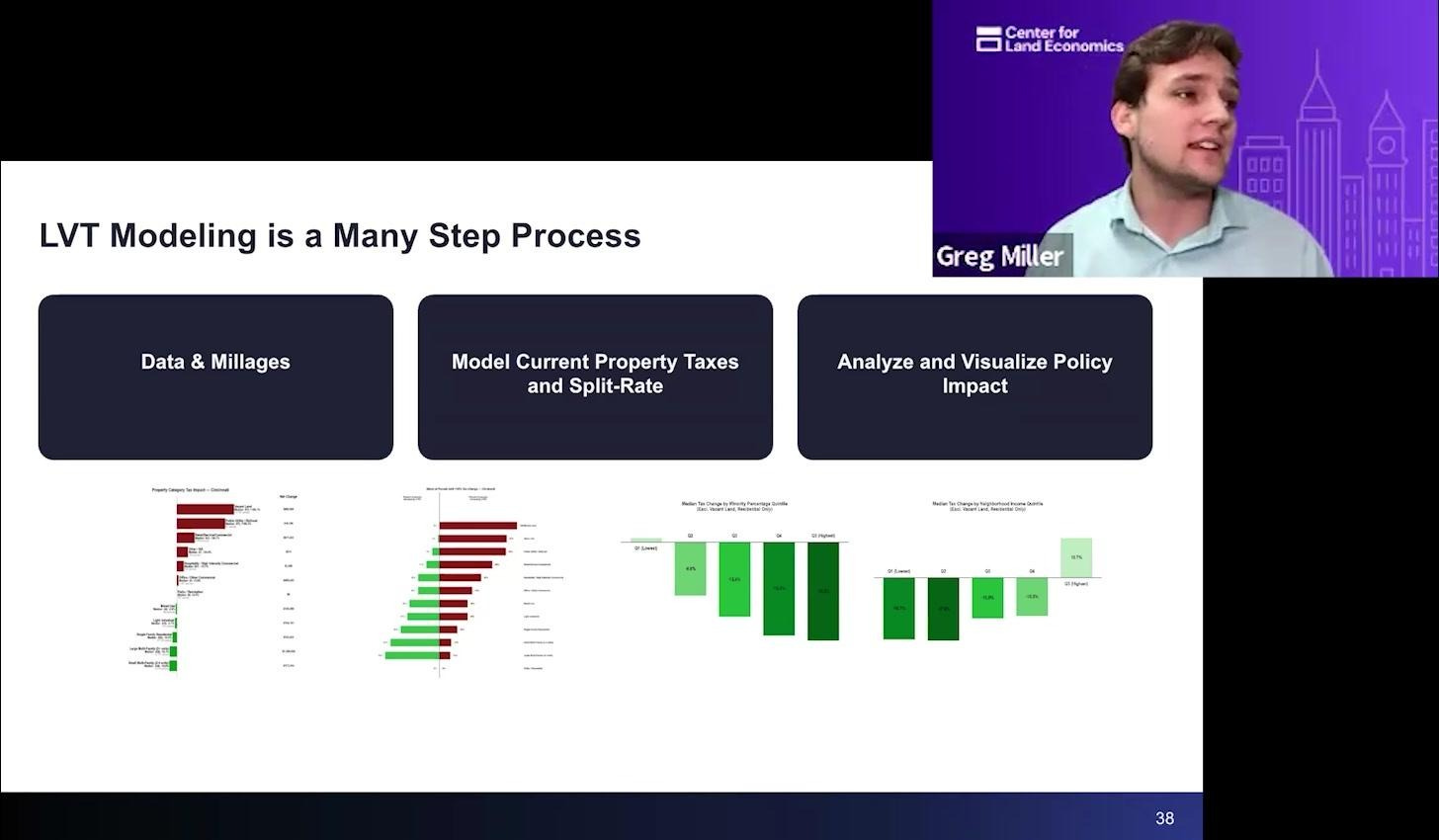
Land value tax modeling is usually a many-step process. You have to find the data, search the county portal, find the millages assessed across every tax levy, translate the data, model current property taxes, account for exemptions and abatements, and then model a split-rate tax. Once you have a per-parcel model, you still have to analyze and visualize the policy impact. That normally takes a lot of time.
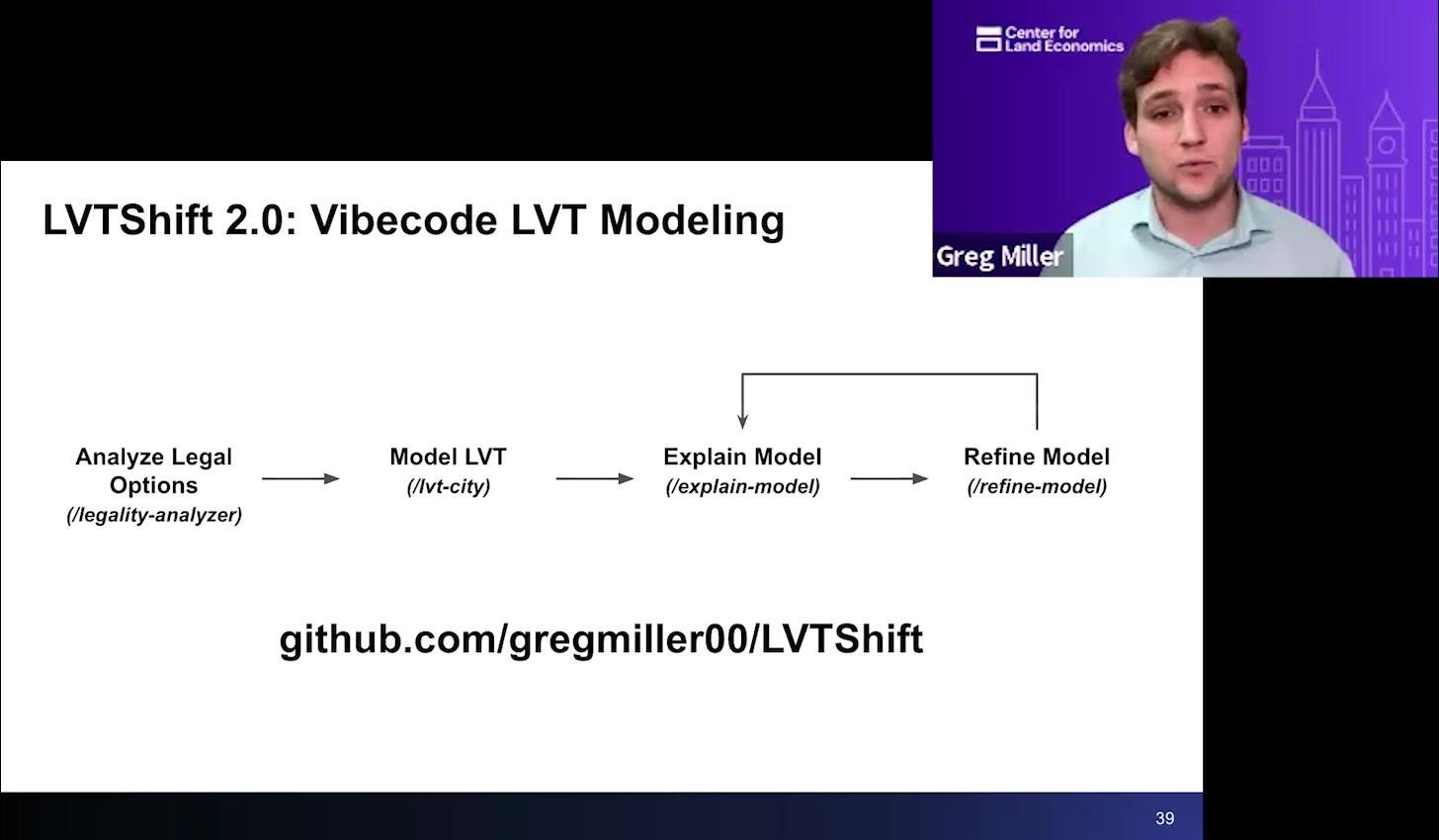
But AI agents can now do a lot of that, so it’s become one command. If you use AI coding agents like Claude Code or Codex, you can go to the LVT Shift project on GitHub and type something like “/lvt-city Cincinnati,” and you’ll get a full set of polished reports and charts that do the LVT-shift modeling for you, which you can then refine.
There are a few different skills. You can analyze a city’s legal options — can it do a universal building exemption, a split rate, and so on? Then you can model the city. Because it’s important to check the AI’s work, you can have it explain the model to you, and once you’ve seen the outputs you can start adjusting and refining. This is just one of many things we’re working on at CLE. There’s more coming on the AI front, including Lars’s work on OpenAVMKit and valuation models for property and land.
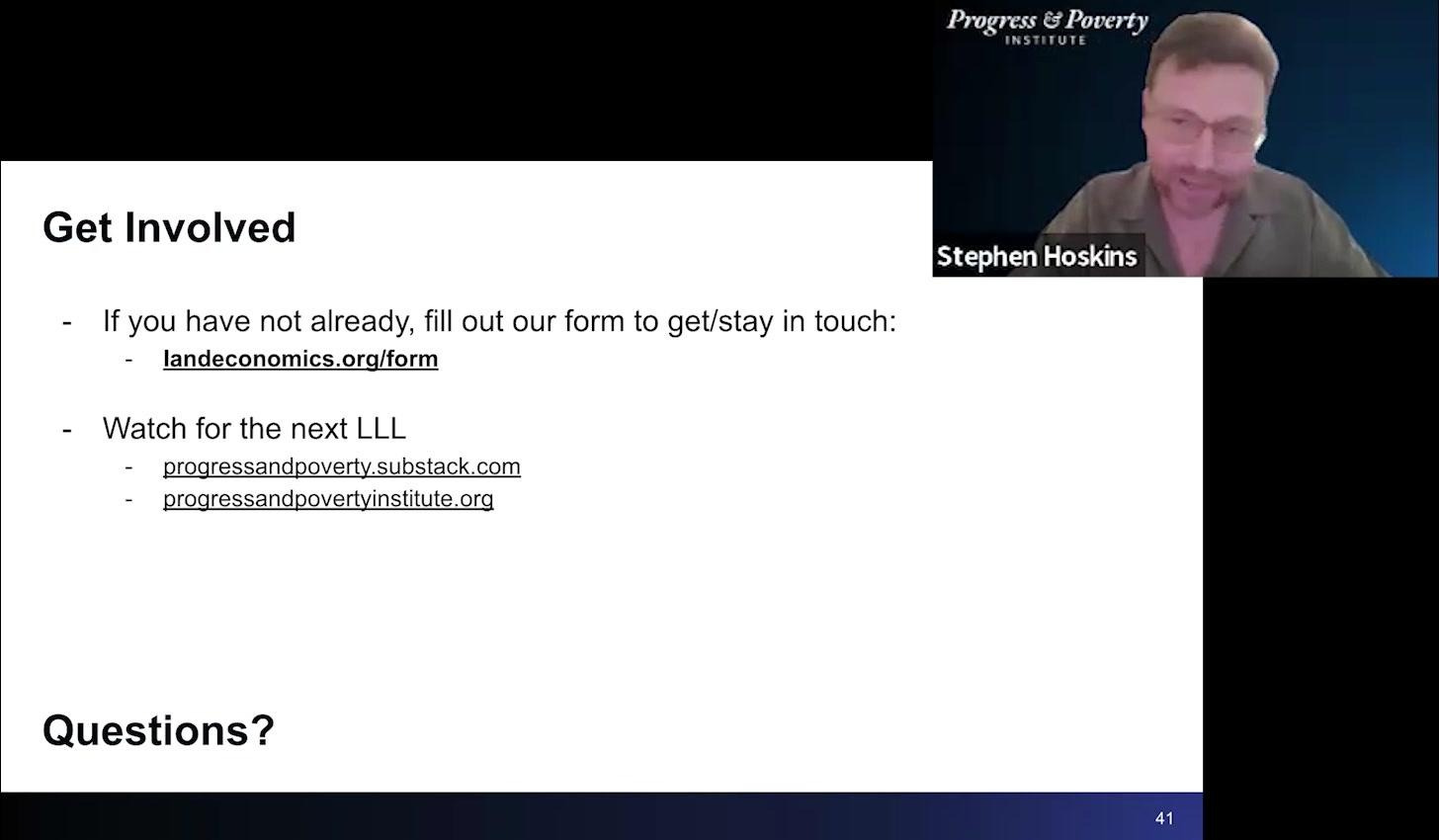
There will be a Progress and Poverty post about this soon. If you’re interested in kickstarting your local LVT advocacy, or you already have something going, please reach out to Steve and me — we’re glad to help you do the homework for your city’s electeds. You can fill out the form at landeconomics.org/form, and watch for our next LVT Landscape LIVE. In the meantime, follow the Progress and Poverty Institute’s weekly newsletter and the Progress and Poverty Substack, where you’ll see the launch of this tool, the recording, and the transcript of this event. Steve, I’ll hand it back to you for questions from the chat.
Questions from the audience
STEVE: I’ll encourage everyone to put questions for our speakers into the chat. A couple of the main ones are probably best for Greg and me to take.
Workarounds for Prop 13 in California?
STEVE: Greg, I have some thoughts, but you might want to weigh in first.
GREG: The Center for Land Economics is also releasing a report on California soon, tied to the wealth-tax debate and the idea of land as wealth that’s easy to tax, because land can’t move. Honestly, I think you eventually just have to get rid of Prop 13. There have been efforts to repeal it for commercial property, which is interesting: commercial would be assessed at market value while residential stays at 1970s values, so commercial would pay something like four times more. But those proposals don’t include vacant land. So if another measure like that goes on the ballot — Tom Steyer was running on this, though his primary results aren’t looking great — we’d argue that if you’re adding commercial, at least add vacant land too, since vacant land also benefits enormously from Prop 13. There are also vacant-building and vacant-land fees you could use. Mostly, I’m hopeful the political pressure on Prop 13 keeps building.
What are the non-negotiables?
STEVE: I’ll pitch this one mainly to Lyle, though others can weigh in. Some second-best options aren’t as efficient as an LVT but achieve similar goals. Raising the stamp duty has economic effects fairly similar to an LVT in terms of capitalization and not discouraging productive activity. Likewise, capital gains mostly come from land value, so lowering the exclusion and raising the rate captures a lot of land value without the worst effects of other taxes. Jackson, Lyle — what carve-outs or exclusions would you accept, and where are your boundaries?
LYLE: I’ve talked with California friends about this a lot. They like the stamp duty; the equivalent here would be a real estate transfer tax. It’s a workaround — not perfect, not LVT, but it gets you in the neighborhood. In Charlottesville we focused on tax relief because it was legal, not because it was perfect. I also pushed hard for tax increment financing, which also isn’t legal in Virginia. Our friends in Arlington managed it with very careful, complicated paperwork and a lot of hopes and dreams. For me, that gets you as close as you can. But LVT is the goal.
JACKSON: For me, I focus on actual real estate taxes rather than auxiliary duties that mimic the effects. When I design a property tax to deliver the benefits of an LVT, I think about land value capture: is the tax actually capturing the value generated for surrounding properties when someone builds a new structure? More importantly, I think about location — is the tax where land value actually matters? There’s no point creating a land value tax in a part of the state where the constraint isn’t land speculation, because nobody’s bidding up the land there. That’s why I was comfortable with a very targeted land value tax in my home city, even though I’d have preferred a full county-wide version.
STEVE: We have time for one or two more.
Can progressive property taxes boost affordability?
STEVE: In Singapore, property owners pay a tax on the annual (essentially rental) value of their property rather than its capital value, and the rates rise with value — a progressive property tax that goes as high as 32% of rental value, even for owner-occupied homes.
So yes, this can clearly help. The American version is a paper Arpit Gupta and co-authors are about to release — I’ll post it — showing, unsurprisingly to this crowd, that places with higher property taxes tend to have more affordable housing, not less. That’s contrary to the usual local-politics claim that we must cut property taxes to help affordability. It’s the opposite: higher property taxes capitalize out of the value of land, lowering the purchase price. You’re trading a high upfront price and low ongoing cost for the reverse, which actually helps people into homeownership. It’s a really useful way to explain that land value tax is a housing-affordability tool — not just by encouraging construction, but by lowering the upfront cost of acquiring property.
Does abolishing property tax raise land prices?
GREG: When you abolish real estate taxes, you raise the selling price of land — the value attributable to the private owner goes up. You don’t necessarily change the raw value of the land; you just raise its upfront selling price. That’s why some young Republicans have come out against this. The Charlie Kirk Show, for instance, has been frustrated with DeSantis’s efforts to abolish property taxes, because they see it as a massive wealth transfer from millennials to boomers — accelerating wealth dynamics that are already playing out. So even within the Republican Party there are real splits on this, which Lars has written about on the Progress and Poverty Substack.
Should cities lease out their land?
GREG: Cities and states own a great deal of land, much of it underdeveloped, and they can acquire more vacant land through proper foreclosure processes. Rather than re-privatizing it, there’s a lot to be done with government land leasing — being better stewards of public land, ensuring it’s developed for the uses the public wants while retaining ownership through 30-, 50-, or 99-year leases. Singapore is a good model, but there are others, including here in the United States, including in Manhattan.
GREG: We’re now about five minutes over, so we’ll close out. Thank you all for coming — this will be recorded and posted — and thank you to our panelists. This was a strong panel of people doing incredible work with real results on the ground. These are exciting times, and we hope the next LVT Landscape LIVE carries this kind of momentum. You’re the ones who can make that happen, so we appreciate you all.