
DALT: Depreciation-Assisted Land Value Tax
One weird trick for turning Property Tax into Land Value Tax

Economists agree Land Value Tax (LVT) is the ideal tax, or at least the “least bad tax,” as Milton Friedman famously put it. Whenever possible, we should prefer a Land Value Tax over any other tax, and here at the Center for Land Economics we’re working hard to make that a legal possibility throughout the United States. While we’re waiting to unlock those barriers, however, we shouldn’t let the perfect be the enemy of the good. In states and cities where constitutional and statutory barriers to LVT haven’t yet been unblocked, there still may be ways to get most of the same economic effects simply by playing with the existing property tax infrastructure.
New York City famously pulled off just such a trick during the 1920’s, leading to a housing boom the likes of which the Big Apple has never seen before or since. The instrument was a temporary property tax abatement on the improvement value of new construction:
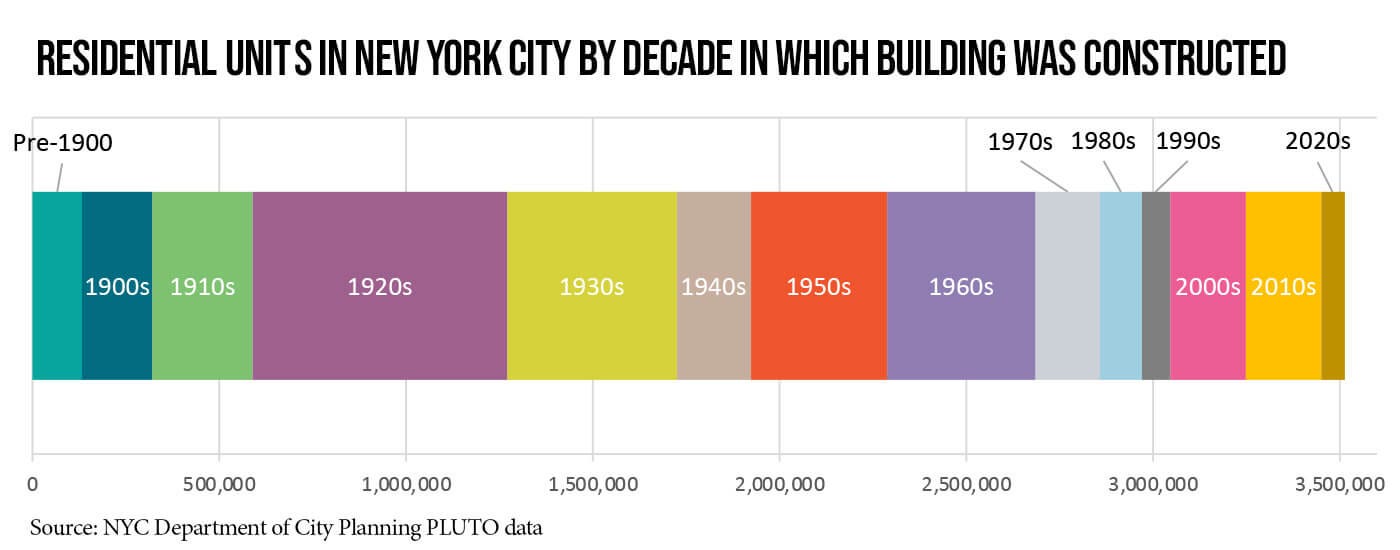
This historical example is the inspiration for a new method I’m going to call “Depreciation-Assisted Land value Tax”, or DALT.
DALT can be enacted anywhere, but it truly shines in markets where buildings reliably depreciate to zero on very short timescales (e.g. twenty years). In such a market, a conventional property tax will yield nearly the exact same economic incentives as a “pure” Land Value Tax, so long as you do one more thing: enact a 10-year tax abatement on the full improvement value of new construction. DALT can also be enacted in markets where buildings depreciate more slowly and still have pretty good effects, with some caveats.
DALT ~ LVT
DALT is exactly the same as a conventional property tax, with one key difference: the improvement value of all buildings are exempt for the first half of their expected lifetimes. Since the bulk of building depreciation is front-loaded, DALT exempts the majority of a building’s total lifetime value. Even better, those savings kick in right at the start, the time where they matter the most.
DALT supercharges building development and also provides a simple legal pathway to a Land Value Tax without having to completely overhaul the assessment system. It also provides most of the economic benefits of LVT: cheaper land selling prices, better land use decisions, less wasteful sprawl, fewer vacant lots held out of use, more affordable housing units, more sustainable municipal finances, and reduced speculation and financialization of land.
As long as you are already competently administering a conventional property tax system, the only additional task you need to enact DALT is to estimate the improvement value of new construction. The good news is that many, if not most, jurisdictions in the US are already doing this anyways, and for those that aren’t, the DALT makes this easier than it usually is. By focusing the abatement exclusively on new construction, any incremental assessment burden lands precisely on the category of buildings whose replacement value is the easiest to estimate—those less than ten years old.
Even better, with a full abatement on new improvements in play, information sharing incentives flip. Instead of property owners hiding data to keep their valuations low, they’re now incentivized to run to the assessor’s office to share their receipts and permits in order to get their tax discount.1
The one catch is this system is most effective in regions where buildings already depreciate rapidly. The poster child for this kind of market is Japan, where real estate famously turns over rapidly and gets rebuilt frequently, but there are other candidates as well: rapidly growing cities, emerging markets, or disaster-prone areas with frequently updated building codes.
The latter are a particularly strong case to consider, because the behavior we want to incentivize there is for builders to make new construction robust to local disasters (earthquake, flood, fire, etc.), However, under conventional property taxes, each new environmental or safety requirement increases the cost of building and thus the property valuation for any building that incorporates them. DALT counteracts this by fully exempting the value of all such disaster-mitigating improvements, making it much cheaper for developers to deploy them.
Sounds nice, but does it actually pencil out? Let’s do the math and find out.
The Math
Imagine a plot of land worth $100K, owned by a developer who has up to $200K to deploy in building capital. If the developer deploys all their capital to build something, the total property would be worth $300K, with 30% of that total value in the land. Buildings depreciate, but land doesn’t. If we assume straight-line building depreciation, a 2% property tax rate, and zero land appreciation, we get this:
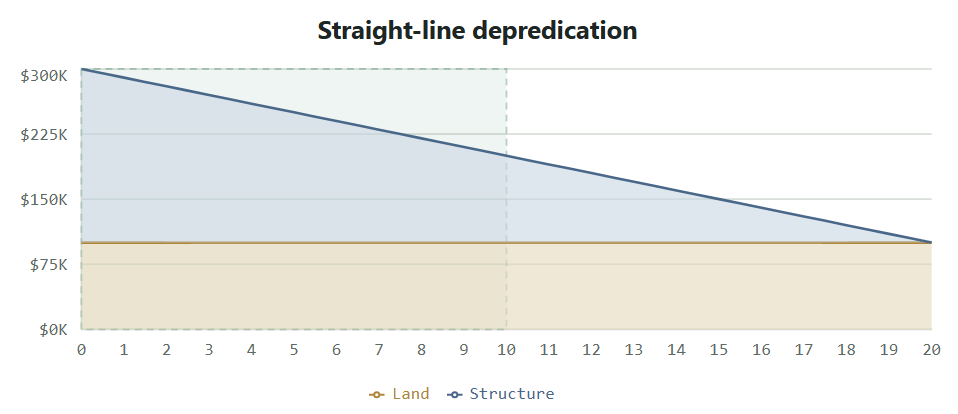
We can see that at year 0, two-thirds of the total property tax will fall on the building, but by year 10, only half of it will, because the building’s value will have declined to $100K, equal to the value of the land. However, straight-line depreciation is an accounting fiction; in the real world, most of a building’s depreciation happens in the first half of its expected lifetime. A more realistic twenty-year depreciation cycle might look like this:
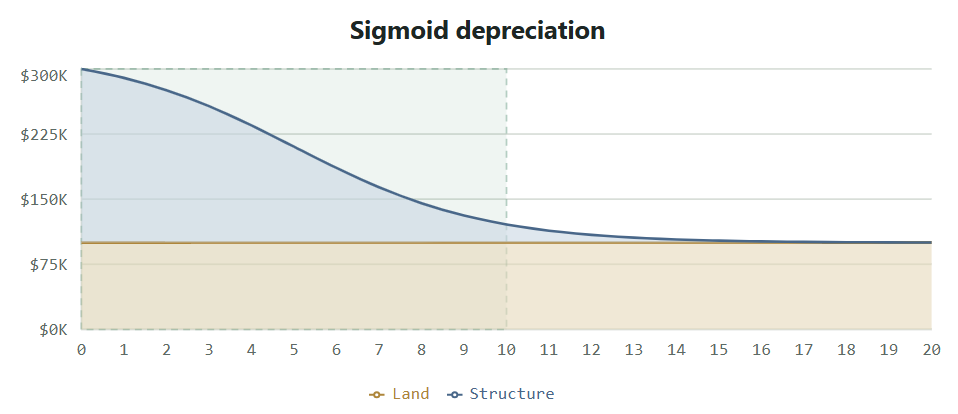
In this model, by year 10 nearly all the building’s value is gone, and land carries most of the tax burden.
Property Tax vs. DALT
If we exempt the first ten years of building value from taxation, we can directly compare DALT to a conventional property tax in terms of how much tax comes from the building versus the land.
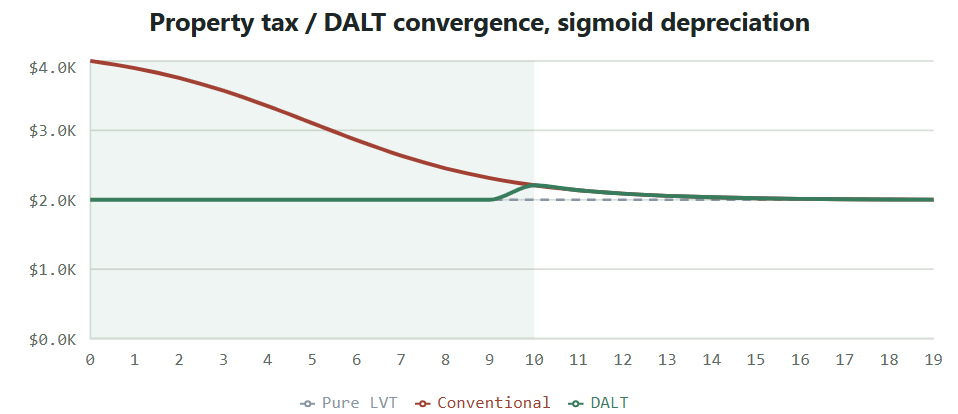
In the graph below, the red line up top is the amount paid in conventional property tax, the green line below it is DALT, and the dotted grey line is a pure Land Value Tax. For simplicity’s sake, all lines assume the same tax rate of 2%2.
We can see that the green DALT line approximates the flat dotted gray LVT line much better than the red property tax line does:
Next, let me add some overlays: the area under the red line is the amount of property tax that comes from the building value. This is divided into two sections: the pink half represents the amount of tax from building value that conventional property tax collects but which DALT does not. The blue half represents the amount of tax from building value that both conventional property tax and DALT collect, but which a pure Land Value Tax would not.
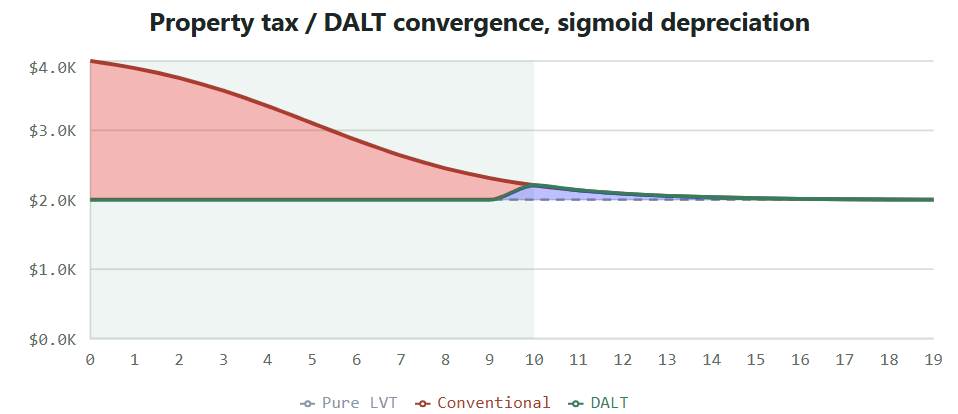
We can see from this that DALT very closely approximates a pure LVT under these conditions, taxing only a small amount of lifetime building value, far less than conventional property tax does.
DALT definitely charges less building tax than conventional property tax, but just as important is when it charges it.
Present Value
Taxes that will be paid at the beginning of a building’s lifetime have the most effect on whether that building gets built in the first place, and how much money gets invested in its construction. This is because of a concept called “Present Value”, which is a method for comparing the value of money you’ll get in the future to the value of money in your pocket today.
For instance: would you rather get a million dollars today, or two million dollars fifty years from now? You’d almost certainly prefer to get the million today, even if you still expect to be alive in fifty years.
To calibrate this, you pick a discount rate, for example, 5%. This means that for each year you have to wait, the value of future money decays by 5%. If that’s your preference, getting $100 a year from now is the same to you as getting $95 right now, and getting it two years from now is worth the same to you as getting $90.25 today. After ten years, the present value of a future $100 decays to ~$60, and in 20 years it’s fallen to ~$35.
Note that even though we’re talking about value “decaying,” this has nothing to do with the physical depreciation of buildings, currency inflation, or anything else, it’s simply expressing the relative value of value itself, in your hands right now, compared to some time in the future, all else equal.
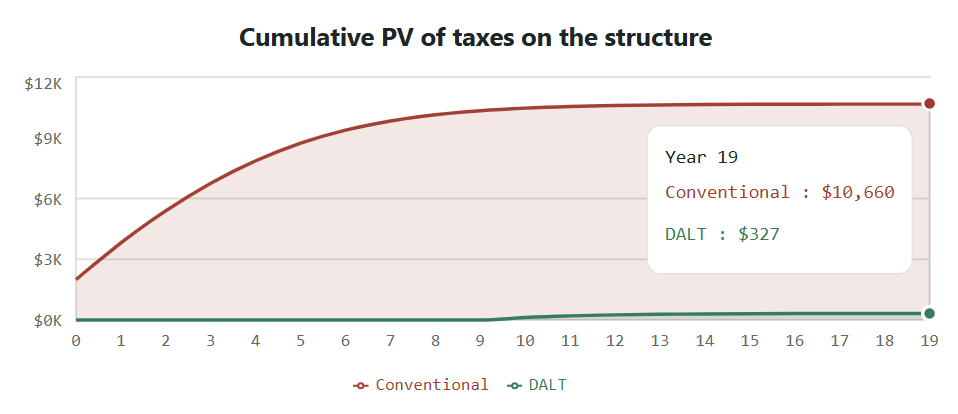
When we take Present Value into account, we can see that exempting the improvement value up front is ideal for two reasons: 1), it’s when improvements are the greatest share of property value, and 2), it’s when the money required to build those improvements is most valuable in present value terms. This makes DALT doubly effective as a building incentive.
When we take this into account and apply to our ongoing example, DALT reduces the PV of building taxes by a whopping 97% when compared to a conventional property tax:
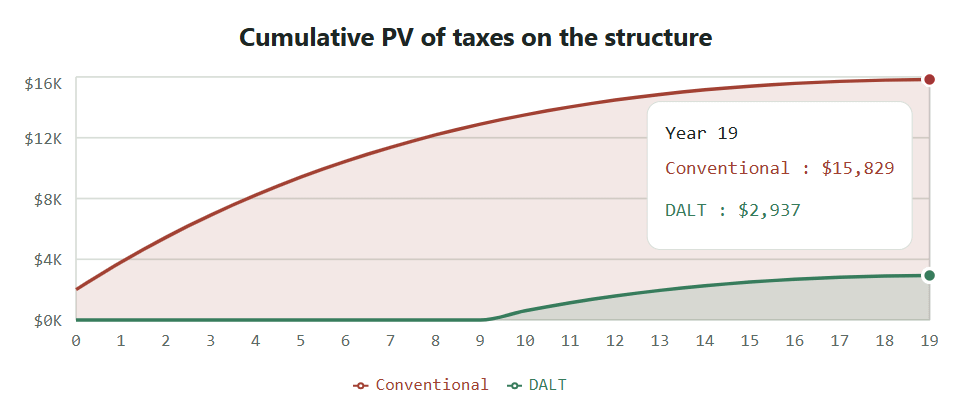
This basic relationship still holds even if we assume less aggressive straight-line depreciation in which only 50% of the building value is gone halfway through its lifetime. In that scenario, DALT reduces the PV of building taxes by a “mere” 81%:
So What?
Okay, so we found a neat trick we can deploy that will allow us to approximate the effects of an LVT if we 1) already have a conventional property tax and 2) happen to have a market where buildings already depreciate rapidly. What does this let us do that we couldn’t before?
For one, it gives us another legislative tool in our kit to get around state constitutions and local statutes that forbid, ban, or limit LVT, such as those in my own home state of Texas.
For instance, Chapter 312 of the Texas State code provides for 10-year tax abatement districts on incremental increases in property value, which could perhaps be used as a legal basis for establishing local DALTs in Texas. I am not a lawyer, but in any locations the legal analysis does check out, this would expand our palette of “Land Value Return” policies to the following:
Pure Land Value Tax
Tax land value directly, but not the buildingsUniversal Building Exemption
Tax total property value, but exempt buildings from taxation. The advantage here is that there is one property tax rate, and existing exemption laws are used to target buildings.Split rate property tax
Tax land and building values at separate rates, and slowly drive the land tax rate up and the building tax rate down.Public land leases
Local governments own land and lease it out at market ratesLocalized Land Value Capture
Any of these policies targeted at special zones, downtown districts, near transit stations, etc.DALT
Tax total property value, but fully exempt the first 10 years of improvement values
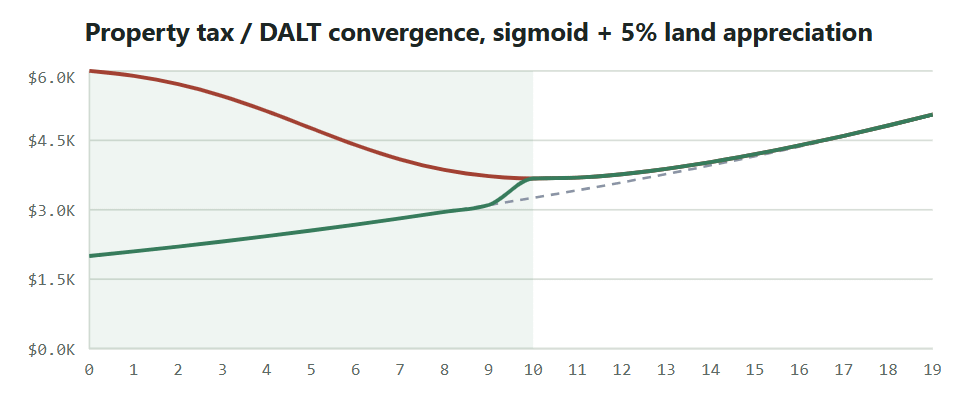
However, there’s another thing DALT lets us do, if we go back to our charts and re-think some of our assumptions. In all our prior examples, the land value was flat over time. However, in actually existing markets where housing prices are rising, we observe that the land value grows over time. What happens to our model if we assume, say, 5% year-over-year land appreciation, as we have indeed seen in many American markets?
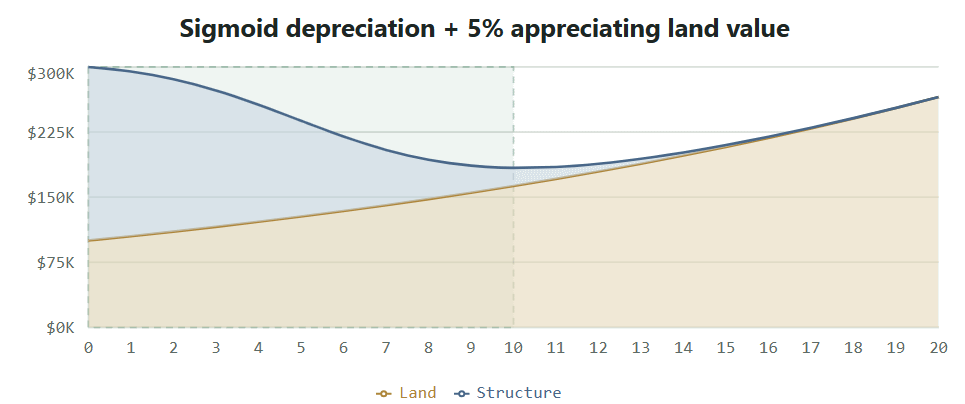
In this scenario, steadily increasing land value will rapidly become the majority of total property value, especially as building value depreciates. This causes DALT and pure LVT to converge even more, with only a slight distortion after the building abatement expires:
Pros and Cons of DALT
In short, DALT:
Gives us most of the benefits of LVT
Has almost none of the downsides of Property Tax relative to LVT
Doesn’t require much new work assessors aren’t likely doing already
Where new construction estimation is an additional burden, DALT asks only for building values which are the easiest to estimate
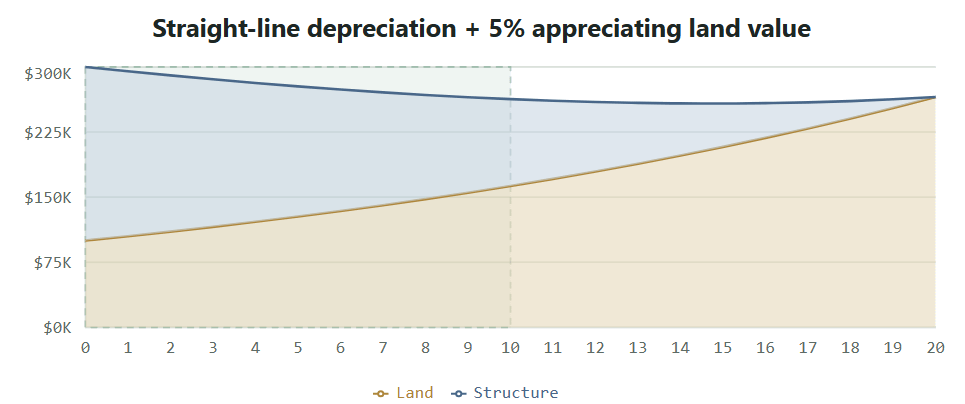
And if estimating depreciation of new construction is still too hard for holdout jurisdictions, then, what the heck, just let them use straight-line depreciation. It’s simple and easy to apply uniformly, and especially in markets where buildings only last twenty years and land value is itself appreciating, DALT will still achieve most of its benefits, especially compared to a conventional property tax:
DALT is a specific tool for a specific scenario, but in the markets for which it applies, it is an easier and more pragmatic tool for achieving most of the effects of a pure LVT without having to hold out for more ambitious legal and assessment reforms. Where the legal and political will exists to implement pure LVT, or an equivalent Land Value Return policy, we should just do that instead. But where we can’t, and DALT is available today, we should consider doing DALT rather than waiting on enabling legislation.
Now, what happens if we implement DALT in a jurisdiction where buildings don’t rapidly depreciate? DALT will still have many benefits, because it will cut out the worst effects of conventional property tax. However, in jurisdictions with long-lived construction, it will introduce a bit of a negative tradeoff: a marginal incentive to tear down and replace buildings, and to invest less in durable, long-lived buildings. This is because the expiration of the improvement abatement creates an incentive for developers to keep as much of the improvement value inside that 10-year window as possible.
In order to incentivize long-lived buildings built with durable materials, we should prefer a pure Land Value Tax over DALT. This is because LVT provides the maximum inducement for developers to freely invest as much as possible into buildings, knowing they will not be punished with higher taxes for more expensive materials and construction methods.
Nevertheless, we should not let the perfect be the enemy of the good. DALT has a lot of potential, as the historical evidence from New York City in the 1920’s shows.
There may be an incentive to exaggerate and inflate construction costs, of course, but the advantage of getting lots of new information is you can cross check values against each other. Additionally, assessors already have access to construction cost tables today, and the tricky part has never been estimating the value of new buildings, but of old, ambiguously depreciated stock.
In a real-world scenario, we would raise the overall tax rate under DALT to remain revenue-neutral
This is brilliant!
So Japan could implement a DALT and it would be virtually the same as the ideal pure LVT.